Showing posts with label green turtle shells. Show all posts

Wednesday, September 27, 2017

Practice Habits: Parents Need Them Too

Welcome to Green semester of Let's Play Music!  Your child is excited to start using the piano and class time is super fun. 


In the first two weeks, your kid is a superstar.... and THEN....  


You might be tempted to let your child slip into lazy practice habits. It goes like this:

"My son is doing fine. He can DO everything the teacher wants him to play, so I think it's fine that he actually only practices once each week. We just get all of the practicing done in one sitting, because it's so easy for him."

"My daughter doesn't spend time at the piano every day, but I saw her in class on lesson 5 and I think she's the best one in class. For her, practicing as-needed is good enough. She feels confident."

The first parent mentioned that her son had met all of the teacher's expectations.  Yes, he can hold his bubble hand.  Yes, he's quick with keyboard geography and his kit-kat keyboard.  Is that the end of the assignment? No!

The Goal of Daily Practice is Daily Practice

In the first several weeks of Green semester, one of our biggest goals is also to establish a daily practice habit.  

As we get into more complicated Green lessons and some challenging Yellow lessons, the students who started out with once-weekly practice really struggle!

My son used to be doing fine in class, but now he's frustrated. He's upset if he can't play everything perfectly on the first day. Get in the habit of practicing daily, so he learns to reach goals over time, not all at once. Once weekly habits set unreal expectations for instant perfection. Establish the daily habit BEFORE the challenging material comes.

My daughter is suddenly frustrated with playing songs that use all 3 chords. She used to be confident in class. Students who get used to 'cramming' for lessons will be frustrated in a few weeks. Playing piano requires building up muscle memory, which requires repeated specific motions. Ear training also takes repeated exposure. You can't CRAM to become a musician! Changing quickly between chords can't be crammed.

Parents: We Need Habits, Too

Establishing a practice habit can be a tricky thing, but this year is the best time to build a solid foundation for both of you.

Obviously the students are working toward building a habit of practice, but I find that, as a parent, I needed to build a habit of supporting practice.  How can we remind ourselves to do our daily supporting role in these early weeks?

Here are four basic strategies, suggested by Gretchen Rubin in her book, Better Than Before, that help solidify a new habit: First Steps, Monitoring, Scheduling, and Accountability.


First Steps/ Getting Started

The strategy of taking the first step essentially means eliminating excuses that hold us back from getting the thing started.

Some personalities enjoy when first steps are big and dramatic: I'm going to go on Biggest Loser and lose 300 pounds! Because it's dramatic, it's fun and exciting to throw yourself into big projects, but ...

Piano will fit easier into real life if we start small, and LPM is designed to help you start small: I'm going to help my child get to the piano every day this week. I know we only need 5 minutes... I can find 5 minutes to spend with him. That's do-able.

Here are few more ways that just getting started can save your habit:

My child doesn't practice because he likes to cram. The goal of daily practice IS daily practice. Help him make a plan to get to the piano bench every day. Once he's on the bench, chances are he will enjoy playing through his pieces. Ever find that it's hard to get your shoes on and get out the door, but once you're jogging, you realize you're having fun?   

My child is so far behind, he doesn't want to practice. Bite of small chunks to make practice happen.  Suggest practicing just part of the list, or just one tricky song or one tricky bit of one song, instead of the whole list. Keep practice to the recommended short time- don't let it become unbearably long. Give lots of positive praise: You said you would practice with a smile for 10 minutes and you did! You stayed really focused the whole time and now you're a little better than you were at the beginning! Great job today. 

Monitoring

The strategy of monitoring/ tracking doesn't require change, but it often leads to change.  Self-measurement brings self-awareness, and self-awareness strengthens self-control!

In order for this strategy to help, REFRAIN from waiting until class day to mark the practice log. We tend to give ourselves more credit for good behavior than we deserve. I'm pretty sure you practiced this five times, I'll just sign your book. 

Not surprisingly, monitoring alone can really help in other arenas...like dieting. Without committing to a specific change, you'll probably make better choices just by knowing you have to consciously acknowledge and track what you eat! If you want to give it a try, check out My Fitness Pal.

If monitoring suits your personality, make a chart for home and mark off days when practicing (and other chores) are done. 

You thought I was talking about a chore chart for my kids, didn't you? I wasn't! I make a chart for myself and give myself credit for cheerfully reminding/ supporting/ encouraging the kids to do their practice and chores! 


Calendars can be especially fun because you'll create a STREAK for yourself. I've been a cheerful piano supporter for 22 days straight...I can't break my streak now! 


In my classroom, students create a streak for themselves by feeding their practice snakes. Each week, if they practiced and did homework, the snake grows by one body part. Everyone is excited to see their snake grow all the way across the wall and down to the floor.  You could create a practice snake at home and let him grow every day if you like.


Scheduling

Scheduling is a tried-and-true strategy.  You'll get important tasks done because you scheduled time for them.  Scheduling works well for your child, too, so they have predictability and routine in these early weeks when practicing is a new skill.

If you haven't already, have a conversation with your child to create a PLAY PLAN to decide when practicing will happen. Don't forget to plan a back-up time, because we all know that conflicts happen. Practicing might also fit into your family's definition of order. We don't eat dessert until after we have dinner, and we don't do playdates until after homework and practice is done.  It might look like this:

Accountability

For many of us, we are more likely to follow through when we know someone else is aware of our efforts, cheering us on, and keeping tabs on us.

Love it or hate it, your Let's Play Music teacher is aware of how much practicing your child is getting done.  If you've been wanting to develop a good practice habit, joining class is a wonderful gift.  You've got a loving, knowledgeable coach on your team. She's checking in on you weekly and willing to help. 

If accountability helps you achieve your goals, tell yourself, I'm going to make a goal to support my son in practicing every day, because I know Ms. Teacher is going to be checking up on me!

Who Practices, Anyway?


Yes, this post is focused on helping YOU, parent, develop a new habit (supporter, reminder, cheerleader) in preparation for helping your child develop his own new habit.

Are the assignments at the beginning of Green semester super easy? Yes! That is intentional to help both you and your child get over the barriers to getting started.

Over the course of the year, your child can take more responsibility for completing and tracking his own practice, but it happens gradually and he'll need you there supporting, reminding, and cheerleading whenever he struggles with his routine.  When he does eventually take over, it will be a sweet reward.

- Gina Weibel, M.S.
Let's Play Music Teacher


Monday, October 6, 2014

Finger Strength Achieved Through FUN!


My barely 5-yo daughter is thrilled to be a Green Turtle student and play songs on the piano like her older siblings.  Unlike her brothers who took Let's Play Music years ago, she has tiny, weak (darling!) little fingers.  Today I share some ideas for strengthening little fingers with ideas you can do both with and without the keyboard.


The Wisdom of Let's Play Music
I am relieved that my daughter has had a year of ear-training, note-reading, vocal-training and harp-playing before being required to demonstrate dexterity and finger strength.  Her mind and ear were ready for Red and Blue level theory and exercises, and she soaked them up.  It would have been a frustrating waste of time, effort and motivation if she'd been sitting at a piano all year, wishing her fingers could keep up with the amazing pace of her mind!  Fingers develop at a slow pace, even for kids with sharp minds, and Let's Play Music planned for it.

Strengthening At the Piano
I can't say enough good things about the drills assigned by LPM teachers.  If your kiddo has weak fingers, never skimp on bubble holding and tapping, individual finger-playing, and kit-kat key pressing!   

This video shows exactly what bubble-hands could look like:


I also have my daughter play the kit-kat song with 2 fingers for the group of 2 (pressing them 4 times before moving on) and 3 fingers on the group of 3.  Our goal is to do it with those nice rounded fingers.

Strengthening Without A Piano
I can't keep her at the piano all day, but luckily there are scores of playful ways to strengthen fingers when we're on-the-go.  The dollar store likely has everything you need for games that will strengthen overall grip/flexion, improve individual finger strength, and improve individual finger control and independent movement.


Sponges: Make a game of filling containers (perhaps during bath time) with water by squeezing a soggy sponge into the container.  Squeezing strengthens wrist muscles and finger flexors.

Bulb Syringe: Maybe you have one of these bulbs left over from when your student was a newborn!? Let her enjoy filling and squeezing the bulb with water at bath time. Ask her to try squeezing with different fingers (only thumb and finger 2? only thumb and finger 3?) Of course every activity is more fun if you fill the bulbs with paint and make it a craft.

Spray bottles: Make cool designs on the sidewalk by squirting water on the cement.  If squeezing seems easy, try using fewer fingers on the trigger! If you've got good weather, fill spray bottles and squeeze bottles with home-made sidewalk spray paint.


Play-doh: We play "mushy pushy."  My daughter holds a ball of dough in her hand and when I say a finger number (or roll a die), she squishes only that finger deep into the dough. There are plenty of play-doh games online to keep your kiddo entertained and squeezing for hours.

Stress-balls: We made our own stress ball by putting flour in a balloon.  Just to be silly, we sing the "flat little red balloon" song instead of "great big red balloon" while squishing it and strengthening fingers.

Finger Exerciser: $6 is a pretty cheap price to pay for a GYM MEMBERSHIP for your fingers. That's what you get when you buy a finger exerciser (available on Amazon.) You can work the whole grip, or each finger individually.

Clothespins: Pick up small items using a clothespin as tongs, or clip clothespins around the edge of your Green Turtles songbook.  Look online for dozens of clothespin educational games  or super-cute animal crafts with opening mouths made from clothespins.  Try opening with different combinations of fingers!

Tennis Ball Puppet: Make a puppet by cutting a mouth slit in a tennis ball.  It takes a strong grip to squeeze his mouth open (and you can hide small objects in there!) Draw eyes with marker or glue on some googley eyes.

I Love You:  Teach your child the classic handsign for "I Love You" and flash it to each other every day!  The ASL (American Sign Language) alphabet and counting numbers also require finger strength and control to shape little hands.  Ask math questions and make a game of only answering with fingers.

I hope these ideas help you and your little one strengthen fingers without getting too frustrated in these early weeks at the piano.  In no time at all her hands will be stronger and she'll be playing chords and intervals with confidence AND be able to remember those hand positions for life.

-Gina Weibel, M.S.
Let's Play Music Teacher


Tuesday, April 1, 2014

Intervals By Ear: Fun with Turtle Tom and Tim


I love how the ear training components of Let's Play Music lessons train students to hear more in the music they are listening to and understand what they are hearing.  With the better understanding of what's happening in music, students are ready to be expressive (and "musical") in their own composing and playing.  It thrills me to know these skills can be taught- anyone can learn to be musically talented!

A Few Types of Ear Training
Let's Play Music classes incorporate chord training: listening to multiple notes played as triads to make Red, Yellow, and Blue chords that we can use to harmonize songs. But there's more!

What Interval Did You Hear?
Pitch Training refers to hearing and identifying specific notes.  C is always C.  G is always G. When we teach students to sing "Do is Home" or "Middle C" with the pitch of Middle C, with no reference to other notes, they are refining their  absolute pitch.

Interval Training refers to identifying one note based on another note by hearing the distance (interval) between the two pitches.  When students sing or identify specific intervals, they are working on their relative pitch.  I've written about the many reasons learning intervals is so helpful to musicians!

Our second year students are learning about playing intervals with their turtle pals in the song Turtle Shells, so I know they'll be excited for a bit more fun interval ear training with the turtles.

Reference Songs: Interval Training

An easy trick for improving relative pitch is to remember a list of your favorite interval reference songs.  Take the first 2 notes of a song you love, and use those notes as a reminder any time you want to sing that interval. 

Great news! Our students have learned lots of songs in Let's Play Music that will serve as great reference songs when I ask them to sing an interval for me.

Let's go an adventure with Tom and Tim, and sing the intervals!

Major 2nd: Sing the "Do-Re" of a major scale, or sing the first two "up, up" of The Red Balloon song.  Tom and Tim begin their adventure by going to the circus to sing the red balloon song to practice this interval.

Major 3rd: Sing "Do-Mi" of the Red chord, or sing "I Am" (first two notes) from the song How to Skip. Tom and Tim skip rope as they sing these notes.

Major 4th: Sing Do-Fa (or Sol-Do) by remembering "Boom Boom!" from the song Ain't it Great to Be Crazy or sing "Tallest Tree" from the song 5 Fat Turkeys. Tom and Tim's next adventure is to find 5 turkeys in that tree.

Major 5th: Sing Do-Sol, or "Hop Hop" from the ostinato of the song Frog Went A-Hoppin, or sing "Twinkle Twinkle" Little Star. Tom and Tim go to the pond and hop-hop-hop on some lily pads.

Here are two more intervals that we aren't using today, but our students are ready to learn:
Minor 2nd: Sing a major scale and focus on Ti-Do at the end. 
Minor 3rd: Sing Sol-Mi, or Hickety Pickety Bumblebee, a song made entirely of this interval.  In our Sound Beginnings class, we have 2 songs every semester focusing on this important interval, since it's the first one young children can learn and sing back on pitch!

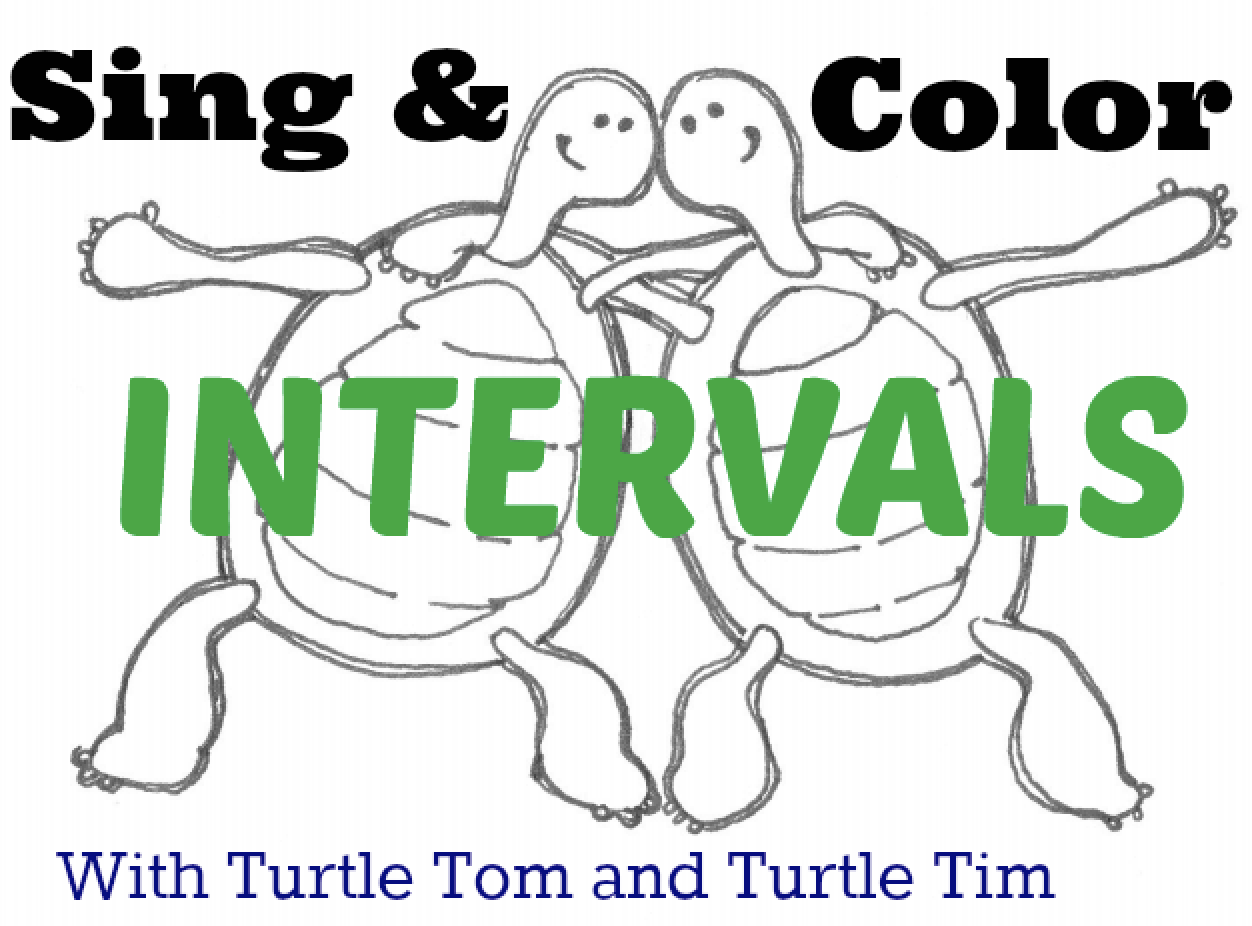
To help my daughter practice and remember these intervals (and because she requested something to color), we made the Adventures of Turtle Tom and Turtle Tim coloring storybook!  

BONUS: The turtles in this story arrange their bodies in the drawings to make each interval (stuck together, stacked up neat, etc.), while singing along to the very song that helps us remember the interval! Can you see how their shells make intervals?

Big Coloring Pages
If you are interested in having pictures to color on two full-sized sheets that are not formatted into a booklet, click HERE.  


MAKE A STORY BOOK BELOW:


Click Image to Download PDF

Assembling your little book:

1. Print the image on 8x11 paper.  Fold along the gray lines, to form 8 sections. Open.
2. Fold in half (short ends together) and cut along the dotted line.  Don't cut too far! 
3. Next, pinch the pages out so the newly-cut seam separates.
4. Adjust the pages nicely so you have a cute little book!  Let your child color and practice singing intervals.

Two Ways to Use The Book

I like to read the story with my daughter, pausing on each page to sing the song.  Then I ask her to sing me just the specified notes (interval) several times.  Then we sing those notes using the solfeg names instead of lyrics several times before going to the next page.

On other days, she has her book in hand, and I play a 'mystery interval' at the piano, or sing it with my voice ("bum-bum").  She flips through her book trying to decide which of the songs I was beginning to sing or play, in other words, she identifies which interval I played!


Wow, Interval Ear-Training Was Easy!
So now you have mastered a few intervals and are off to a great start!  There are a few more to learn (and be sure to recognize and sing them descending as well as ascending), and luckily there are some websites like this and this where you can add more songs and do some drills to get better.  Have fun!

-Gina Weibel, M.S.
Let's Play Music Teacher

Related Posts:
Musical Superpower: Perfect Pitch
Intervals are Worth Knowing