
"Wow, I love this new song! It has a really great beat." What does it really mean when a song has a great beat?
Today I'll break down the difference between some useful music words like beat, meter, rhythm, and tempo. We are always talking about how important it is to give students lots of experience with finding beat, matching beat, and keeping steady beat, so today I'll make sure readers know what we mean and give you some ideas of how to get the beat at home.
Steady Beat Quiz
A beat is nothing more than a steady pulse. Voila. Boring? Maybe. But really important. Everything else in music will be centered around, and defined by that pulse.
Young musicians practice listening to music and identifying the beat, then trying to move with it and keep that beat going. Games like tambourine train in Let's Play Music give us practice moving to the beat.
All babies and children inherently play and dance to matching beat. This little cutie is the daughter of Let's Play Music teacher, Darlayne Coughlin, in Wisconsin. When your Mom leads the drum corps for the Green Bay Packers, you get plenty of chances to match the beat. She can't help but let her body move when she hears it. All babies and toddlers benefit from an environment filled with music and rhythm: they will naturally look for a steady pulse and try to move to it.
Now that you and your child are in Let's Play Music, you can consciously work on getting even better at matching a beat. Interested to see how well you can already keep a steady beat? Take this quick test (and maybe post your results in the comments). When someone can maintain a steady beat, we say they've "got rhythm."
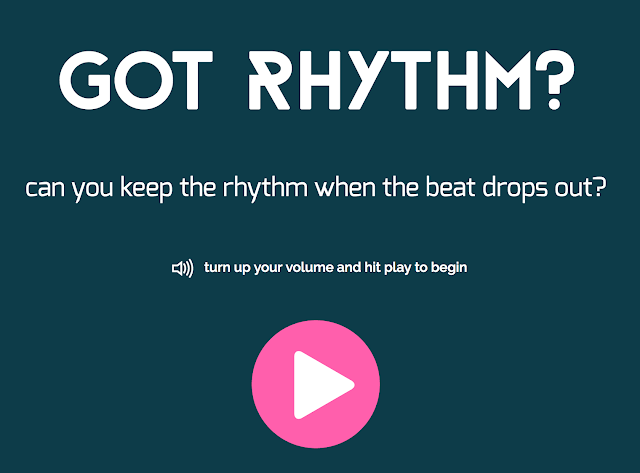
You tried to keep all of your taps spaced evenly and precisely in time. That means you can maintain a steady beat after hearing it tapped out for you. Great job! If some beats were too early and some too late, it means you're human and have room for improvement.
A more natural example of beat-finding would be listening to real music and clapping along to the beat. Because the tempo (speed of music) is different for many styles of music, this is definitely worth practicing.
In the first 3:00 minutes of this video from Hoffman Piano Academy, you'll be challenged to clap along to some piano pieces of different tempi. Can you do it?
The beat is the steady underlying pulse of the music. Importantly, the beat continues steadily even when no instruments or voice sound on the beat. Conversely, there can be lots of sounds happening all in a single beat of time.
 All of the sound and silence organized in time is rhythm. Rhythm is a pattern of durations, organized on top of the beat. To understand and perform rhythms, the student must first interpret the steady beat supporting them.
In Sound Beginnings class, a heart map (beat map) helps students tap along to the beat of a song. I love using the heart symbol because it reminds us that the heartbeat is a natural steady beat children are familiar with. When we sing songs like May There Always Be Me in Let's Play Music, we have a chance to find a beat and pat along to it. Here's a worksheet used by piano teacher, Susan Paradis.
Rhythms create silence on some beats (rests or notes that carry over for more than one heart) and multiple sounds within other beats (eighth notes, sixteenth notes, and combinations of them). In the rhythm worksheet, students can insert notes or rests for each beat of the music to create their own rhythm. Watch the Hoffman video again (starting at 3:20) to see an example of how to use the heart beat map.
As we sing a song, we could tap each heart steadily in progression: this is keeping the beat. Or we can clap along with the quick and slow pauses that are played by the instruments or sung with lyrics: this is playing the rhythm.
 Rhythm is exciting and fun! Read about our Blue Bugs for an inside look at how rhythm syllables will help your student learn to perform them easily and correctly.
Also check out the Theta Music Trainer website for games that help you combine notes to create rhythms.
Meter is one more important piece to rhythmic understanding. Meter is the recurring pattern of stronger and weaker beats. It is what gives music its ebb and flow and determines the time signature of a piece. Notice in the worksheet above, each line says 4/4 (time signature), denoting the meter.
Here is your handy dandy time signature decoder: the top note tells you how many beats are in a measure. The bottom note tells you what type of note is going to get one beat. So there are four beats per measure and a quarter note would be one beat in 4/4 time.
A measure is simply a 'chunk' of beats. Importantly, the first beat of each measure, the downbeat, is felt with more emphasis. After listening to a few measures of music, you'll start to feel that every fourth beat is a downbeat (4/4 time). Or perhaps every third beat has the emphasis (3/4 time). Try it: this video plays a cute piano tune with both 3/4 and 4/4 time. I especially like the part where you (and your student) can follow along with the notation as the notes play- can you read what you are hearing?
Audiation and Rhythm
While a child may be able to perform a steady beat, we also want him to feel a steady beat.
Did you catch that subtlety? One step is performing (clapping/tapping) the beat along with a song or even all alone to keep a steady beat. The next level is being able to audiate that beat and keep it going during parts of the song when sustained notes require counting several beats.
Audiation is the mental/ internal hearing of music or beat when there is no external instrumentation. In other words, can you keep a steady beat going in your mind even when you're not tapping it out on a drum? Rhythm cannot be audiated without a metric context; therefore, never rely on rhythm syllables to generate the rhythm without an established beat and meter first.
You Got the Beat at Home!
So when I say, "I love this song! It has a great beat!" that's technically silly: every song has a great beat. What we all know I mean is it has a strong bass line (an instrument is clearly tapping out the beat, as a base layer, like in pop music). That makes it easy for me to identify the beat, and if the tempo is peppy, I probably want to dance!
Many activities in Sound Beginnings and Let’s Play Music are centered on developing this capacity to match a beat, then eventually feel and 'hear' a steady beat where there is no beat actually being sounded. Here are some fun ways you can strengthen these skills at home:

- Show Him the Beat: Take your child in your lap and rock him to the beat of the lullaby you listen to. Even better, as you rock to the beat, also pat his back. You're helping him see that he can move and tap to match what he hears. When driving in the car with a fussy child, I reached my hand back and squeezed her foot to the beat of the music we were listening to. She got very quiet and focused on trying to wiggle her ankle to the beat to respond to me.
- Heart Maps: Use your heart beat map from Sound Beginnings, or just draw 8 hearts on paper and help your preschooler tap along as you sing a song. Make it a fun game by pulling strips from a jar with song titles so the next song is a surprise.
- Family Dance Time: Don't be shy at home! Encourage youngsters to move and dance to music. Bouncing, marching, and clapping to the beat are critical developmental skills and super fun. Make it a tradition (after dinner?) or just anytime: pump up the sound and start dancing.
- Easy Percussion: You don't have to spend a lot on percussion instruments (but musical gifts are delightful). Grab a couple wooden spoons or a pot to bang on and let your kids tap to the music. The BEST gift you can give them is if YOU play, too. Model how it goes to have fun in a homemade band.
- Transitions: Kids want to play with music and rhythm if it's silly. Try marching (to the bus stop, to the dinner table, to the bath tub) and chanting on beat. "Let's march, to the bus, here we go, we do not fuss. You will go to school today. You will get to read and play." Invented silly lyrics are a bonus. Your kids will giggle, march, and chant along.
- Make it Pop: 99% of pop music is structured with a vocal line over layers of repeating rhythmic patterns. Focus on those underlying rhythms as you clap along. And don't fret; the world has tons of great kid's pop artists that won't drive parents batty. Check out Ralph's World, Stevesongs, Laurie Berkner, and add your favorites in the comments!
- Song Cubes: For this fun game you make two big dice. One has names of songs on it, the other has ways to express the rhythm. Roll the dice and play/sing with your toddler!

- Musical Environment: Experiment with ways to add more music to the environment. Does your child respond well to peppy tunes while dressing in the morning? Lullabies at bedtime? When I see my little ones engaged in puzzles or imaginary play, I often turn on some quiet classical music as background music. They don't even notice, but a few minutes later they are humming along or nodding to the beat. Exposure, even if it doesn't count as deliberate practice, will still help kids internalize the feels and sounds of music and beats.
- Deliberate Listening in the Car: On the other hand, take time to listen when nothing else is distracting. Buckled in the car is one great time. Talk to your child about what you hear. "Let's see if we can dance to this song with just our heads nodding. Can you clap along to this song? Say bum-bum-bum with the drum in this song!"

- Gina Weibel, M.S.
Let's Play Music teacher


