
Showing posts with label coloring. Show all posts

Thursday, April 24, 2014

Your Very First Recital!


If you've just enjoyed most of your first year of the Let's Play Music curriculum, then that means you're preparing for your child's very first Let's Play Music recital!

Practice Counts
This year practice has been very flexible: do the homework assignment, listen to the CD  and sing along, practice the bell songs a few times, and repeat any games and activities from class that you love.  You didn't have to record if practice was daily.  It was easy and fun!

During these last few weeks, practicing becomes a bit more intense (and still fun); now your child will need to practice exactly the bell songs she's be assigned to perform for the recital.  It will be important to practice EVERY day for the week or two leading up to the show.

This gentle spurt of effort is a great way to prepare Blue Bugs for the joys of becoming Green Turtles, since they'll be expected to practice at least 5 times/ week.  Explore strategies for helping your child enjoy this daily practice now, and get her excited to continue daily practices next fall.

10-Day Practice Log

My daughter is very motivated by coloring, so I designed a 10-day practice log, scheduled to end on the day of the recital.  Click on the image to download one for your eager musician.  If she plays her songs 3-4 times every day for 10 days, she definitely will be perfectly prepared for the show.

Download Recital Practice Chart

Click the image to download the practice chart.

A Few Things They Learned
The recital is more than just darling children singing songs; it's an opportunity to delightfully reminisce about the fabulous skills they've learned this year!  I chose my favorite ten characters to feature in the practice log.  Maybe you'll want to revisit their songs as you color in each space. Let's see what they taught us:

Bill Grogan's Goat: We learned how to find a beat, feel the beat internally, and accompany singers on the harp while keeping the beat.  We even listened and identified out the common melody notes Sol-La-Ti-Do.

Frog Went Hoppin': We learned how to read leaps on the staff, and play a song with leaps on our bells.  We identified the bug-bug-slug rhythm of the ostinato.

Oooo Halloween: We expanded our vocal range and practiced singing with a pleasant head voice.  We carried the beat internally and were able to surprise our friends.

Hickety Pickety Bumblebee: We sang a minor 3rd interval (Sol-Mi) on correct pitch and played the song on our bells with 3 different melodic endings that we learned to identify by ear or notation.  We learned to play this song in the key of C (Do is C) and F (Do is F).

Jungle Drums: We were able to keep a steady beat while subdividing.  We noticed the mathematics of subdividing and played our rhythm while others played different rhythms.

Bug Rhythms: We learned to read rhythms and play them correctly with or without using our voice.

The Dinosaur Song: We learned how to read steps and skips and play this song using steps and skips on our bells.  We learned that songs have melody, and we identified and sang the solfeg.   **For the dinosaur enthusiasts: Yes, I have been told that dinosaurs of that diplodocus-like shape did NOT have spikes, but all the dinosaurs that DO have spikes are not really shaped for climbing up and sliding down.  So, this drawing is a dinosaur dressed up as a stegosaurus for Halloween.**

The Red Balloon: We learned to sing a major scale ascending and descending, and identify a major scale by ear or notation.  We learned all the solfeg and accompanying hand signs.

Five Fat Turkeys: We were able to pick out the melody and identify sol-sol-do in this song.  We learned to keep the beat while singing and doing hand actions, and we played this song on the autoharp while reading from a chording sheet.


BINGO: We clapped and audiated rhythms, and even identified the bug rhythms used in this song.  With careful listening, we discovered the melody, too, and notated the sol-la-ti-do at the end!


Have a wonderful time coloring and I wish you the best at your very first Let's Play Music recital!

-Gina Weibel, M.S.
Let's Play Music Teacher

Tuesday, April 1, 2014

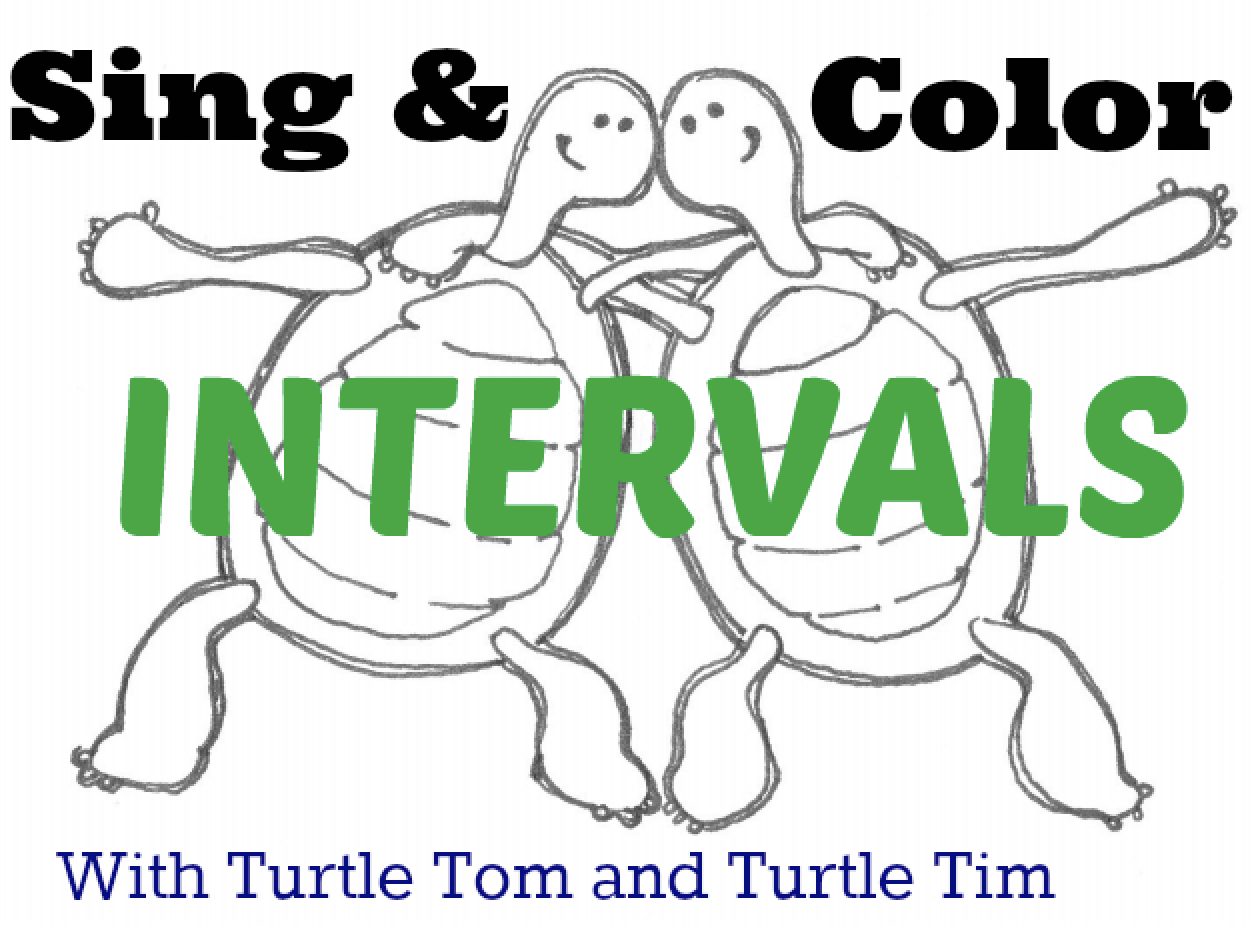
Intervals By Ear: Fun with Turtle Tom and Tim


I love how the ear training components of Let's Play Music lessons train students to hear more in the music they are listening to and understand what they are hearing.  With the better understanding of what's happening in music, students are ready to be expressive (and "musical") in their own composing and playing.  It thrills me to know these skills can be taught- anyone can learn to be musically talented!

A Few Types of Ear Training
Let's Play Music classes incorporate chord training: listening to multiple notes played as triads to make Red, Yellow, and Blue chords that we can use to harmonize songs. But there's more!

What Interval Did You Hear?
Pitch Training refers to hearing and identifying specific notes.  C is always C.  G is always G. When we teach students to sing "Do is Home" or "Middle C" with the pitch of Middle C, with no reference to other notes, they are refining their  absolute pitch.

Interval Training refers to identifying one note based on another note by hearing the distance (interval) between the two pitches.  When students sing or identify specific intervals, they are working on their relative pitch.  I've written about the many reasons learning intervals is so helpful to musicians!

Our second year students are learning about playing intervals with their turtle pals in the song Turtle Shells, so I know they'll be excited for a bit more fun interval ear training with the turtles.

Reference Songs: Interval Training

An easy trick for improving relative pitch is to remember a list of your favorite interval reference songs.  Take the first 2 notes of a song you love, and use those notes as a reminder any time you want to sing that interval. 

Great news! Our students have learned lots of songs in Let's Play Music that will serve as great reference songs when I ask them to sing an interval for me.

Let's go an adventure with Tom and Tim, and sing the intervals!

Major 2nd: Sing the "Do-Re" of a major scale, or sing the first two "up, up" of The Red Balloon song.  Tom and Tim begin their adventure by going to the circus to sing the red balloon song to practice this interval.

Major 3rd: Sing "Do-Mi" of the Red chord, or sing "I Am" (first two notes) from the song How to Skip. Tom and Tim skip rope as they sing these notes.

Major 4th: Sing Do-Fa (or Sol-Do) by remembering "Boom Boom!" from the song Ain't it Great to Be Crazy or sing "Tallest Tree" from the song 5 Fat Turkeys. Tom and Tim's next adventure is to find 5 turkeys in that tree.

Major 5th: Sing Do-Sol, or "Hop Hop" from the ostinato of the song Frog Went A-Hoppin, or sing "Twinkle Twinkle" Little Star. Tom and Tim go to the pond and hop-hop-hop on some lily pads.

Here are two more intervals that we aren't using today, but our students are ready to learn:
Minor 2nd: Sing a major scale and focus on Ti-Do at the end. 
Minor 3rd: Sing Sol-Mi, or Hickety Pickety Bumblebee, a song made entirely of this interval.  In our Sound Beginnings class, we have 2 songs every semester focusing on this important interval, since it's the first one young children can learn and sing back on pitch!

To help my daughter practice and remember these intervals (and because she requested something to color), we made the Adventures of Turtle Tom and Turtle Tim coloring storybook!  

BONUS: The turtles in this story arrange their bodies in the drawings to make each interval (stuck together, stacked up neat, etc.), while singing along to the very song that helps us remember the interval! Can you see how their shells make intervals?

Big Coloring Pages
If you are interested in having pictures to color on two full-sized sheets that are not formatted into a booklet, click HERE.  


MAKE A STORY BOOK BELOW:


Click Image to Download PDF

Assembling your little book:

1. Print the image on 8x11 paper.  Fold along the gray lines, to form 8 sections. Open.
2. Fold in half (short ends together) and cut along the dotted line.  Don't cut too far! 
3. Next, pinch the pages out so the newly-cut seam separates.
4. Adjust the pages nicely so you have a cute little book!  Let your child color and practice singing intervals.

Two Ways to Use The Book

I like to read the story with my daughter, pausing on each page to sing the song.  Then I ask her to sing me just the specified notes (interval) several times.  Then we sing those notes using the solfeg names instead of lyrics several times before going to the next page.

On other days, she has her book in hand, and I play a 'mystery interval' at the piano, or sing it with my voice ("bum-bum").  She flips through her book trying to decide which of the songs I was beginning to sing or play, in other words, she identifies which interval I played!


Wow, Interval Ear-Training Was Easy!
So now you have mastered a few intervals and are off to a great start!  There are a few more to learn (and be sure to recognize and sing them descending as well as ascending), and luckily there are some websites like this and this where you can add more songs and do some drills to get better.  Have fun!

-Gina Weibel, M.S.
Let's Play Music Teacher
Related Posts:
Musical Superpower: Perfect Pitch
Intervals are Worth Knowing


Friday, October 25, 2013

Halloween Coloring: Witches, Black Cats, Goblins, too!

Trick-or-treat!  

I have a treat for you that won't cause cavities- it's a Halloween coloring page.

The Red semester Let's Play Music students are singing about witches, black cats, and goblins, too in our song, "Halloween is Coming".  

To help them remember those tricky words, I've got a coloring page filled with those sneaky ghouls.  All will try to frighten you (but they won't be able to, will they?).  Click on the image to download the file.

Extend Your Vocal Range

This treat has a little trick, too- we trick the students into working out their vocals with all those ghostly swoops and windy howls.  

For this song, we practice making the mouth, jaw, and throat shape that will help create better tones and reach higher notes.  Hint: yawn and notice the position of the back of your throat and jaw.  While holding that mouth-shape, sing "oo-oo-oo" to the melody of the song. This excellent exercise improves voice control and pitch-matching.

It's not uncommon for youngsters to sing melodies or scales without changing pitch much at all.  A major scale may sound rather monotone until the student learns to expand her vocal range.  These swooping howls will help achieve that goal!

Trick-or-Treat!

Are you planning to go out trick-or-treating?  You'll probably sing "trick-or-treat" with a sol-sol-mi.  Try playing it on your bells!  Sol-mi is the first interval (minor 3rd) that youngsters can identify and accurately reproduce. We start ear training with that interval, then expand to add other pitches.

Now that you're a music student, try singing trick-or-treat with these trickier melodies. Use your bells or piano to listen first, then try to say "trick-or-treat" with these pitches:

* SOL- MI- SOL
* MI- RE- DO
* SOL- SOL- DO
* SOL- LA- TI- DO (Tri-ick or treat!)
* SOL- FA- MI- RE- DO (Tri- ick o-or treat!)
* SOL- MI- DO 

Read and Compose at Home

All semesters of Let's Play Music students can enjoy more sight-reading on bells or piano.  Here are the Halloween pals to download and cut out.  They're round so you can use them as notes on a homemade staff.  

Make a major scale, create a melody for bells, or quiz each other on steps, skips, and intervals.  And finally, have a safe and fun Halloween. (The 5 fat turkeys are already looking forward to Thanksgiving, so they snuck in there, too.)


-Gina Weibel, M.S.
Let's Play Music teacher