
Showing posts with label education. Show all posts

Tuesday, April 1, 2014

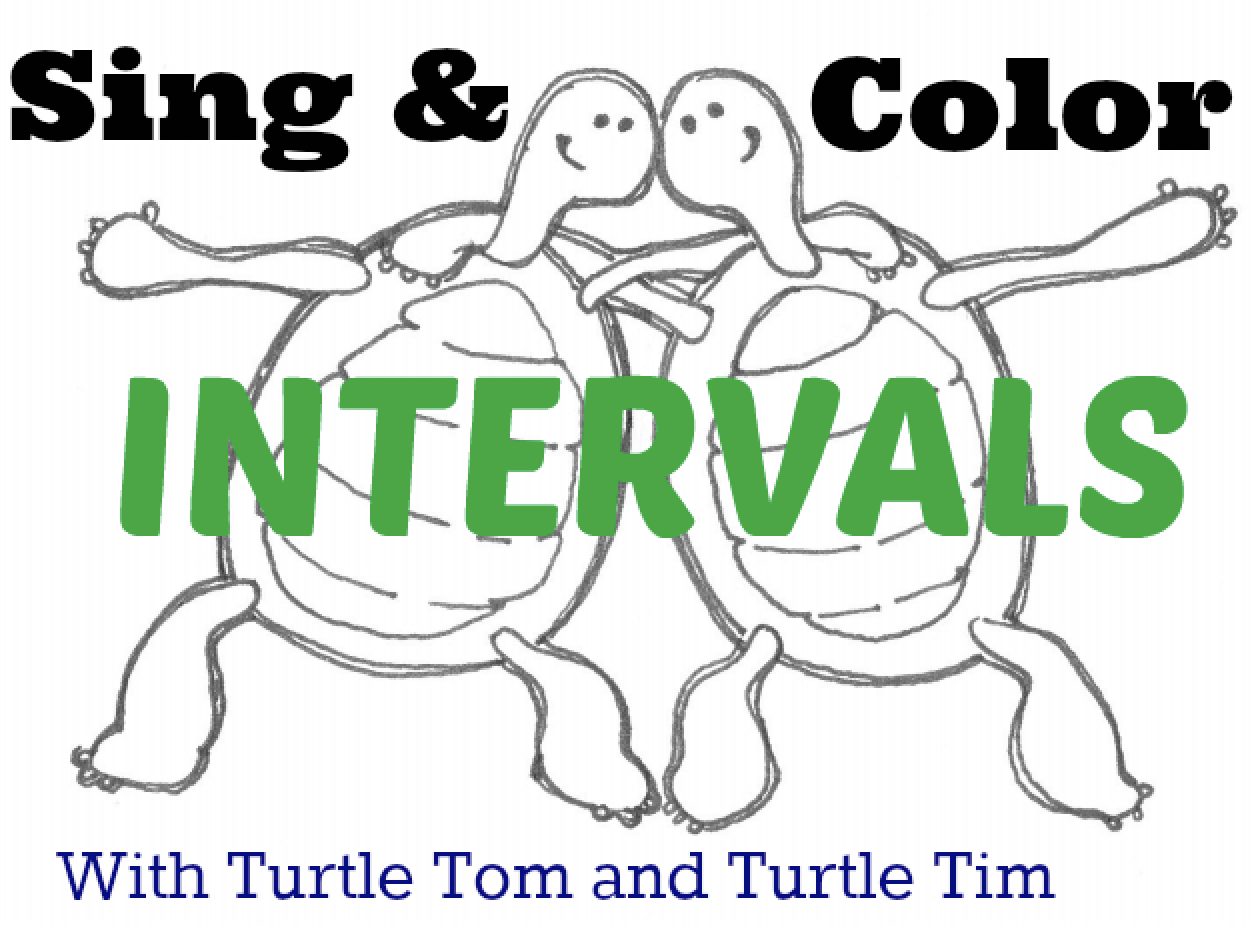
Intervals By Ear: Fun with Turtle Tom and Tim


I love how the ear training components of Let's Play Music lessons train students to hear more in the music they are listening to and understand what they are hearing.  With the better understanding of what's happening in music, students are ready to be expressive (and "musical") in their own composing and playing.  It thrills me to know these skills can be taught- anyone can learn to be musically talented!

A Few Types of Ear Training
Let's Play Music classes incorporate chord training: listening to multiple notes played as triads to make Red, Yellow, and Blue chords that we can use to harmonize songs. But there's more!

What Interval Did You Hear?
Pitch Training refers to hearing and identifying specific notes.  C is always C.  G is always G. When we teach students to sing "Do is Home" or "Middle C" with the pitch of Middle C, with no reference to other notes, they are refining their  absolute pitch.

Interval Training refers to identifying one note based on another note by hearing the distance (interval) between the two pitches.  When students sing or identify specific intervals, they are working on their relative pitch.  I've written about the many reasons learning intervals is so helpful to musicians!

Our second year students are learning about playing intervals with their turtle pals in the song Turtle Shells, so I know they'll be excited for a bit more fun interval ear training with the turtles.

Reference Songs: Interval Training

An easy trick for improving relative pitch is to remember a list of your favorite interval reference songs.  Take the first 2 notes of a song you love, and use those notes as a reminder any time you want to sing that interval. 

Great news! Our students have learned lots of songs in Let's Play Music that will serve as great reference songs when I ask them to sing an interval for me.

Let's go an adventure with Tom and Tim, and sing the intervals!

Major 2nd: Sing the "Do-Re" of a major scale, or sing the first two "up, up" of The Red Balloon song.  Tom and Tim begin their adventure by going to the circus to sing the red balloon song to practice this interval.

Major 3rd: Sing "Do-Mi" of the Red chord, or sing "I Am" (first two notes) from the song How to Skip. Tom and Tim skip rope as they sing these notes.

Major 4th: Sing Do-Fa (or Sol-Do) by remembering "Boom Boom!" from the song Ain't it Great to Be Crazy or sing "Tallest Tree" from the song 5 Fat Turkeys. Tom and Tim's next adventure is to find 5 turkeys in that tree.

Major 5th: Sing Do-Sol, or "Hop Hop" from the ostinato of the song Frog Went A-Hoppin, or sing "Twinkle Twinkle" Little Star. Tom and Tim go to the pond and hop-hop-hop on some lily pads.

Here are two more intervals that we aren't using today, but our students are ready to learn:
Minor 2nd: Sing a major scale and focus on Ti-Do at the end. 
Minor 3rd: Sing Sol-Mi, or Hickety Pickety Bumblebee, a song made entirely of this interval.  In our Sound Beginnings class, we have 2 songs every semester focusing on this important interval, since it's the first one young children can learn and sing back on pitch!

To help my daughter practice and remember these intervals (and because she requested something to color), we made the Adventures of Turtle Tom and Turtle Tim coloring storybook!  

BONUS: The turtles in this story arrange their bodies in the drawings to make each interval (stuck together, stacked up neat, etc.), while singing along to the very song that helps us remember the interval! Can you see how their shells make intervals?

Big Coloring Pages
If you are interested in having pictures to color on two full-sized sheets that are not formatted into a booklet, click HERE.  


MAKE A STORY BOOK BELOW:


Click Image to Download PDF

Assembling your little book:

1. Print the image on 8x11 paper.  Fold along the gray lines, to form 8 sections. Open.
2. Fold in half (short ends together) and cut along the dotted line.  Don't cut too far! 
3. Next, pinch the pages out so the newly-cut seam separates.
4. Adjust the pages nicely so you have a cute little book!  Let your child color and practice singing intervals.

Two Ways to Use The Book

I like to read the story with my daughter, pausing on each page to sing the song.  Then I ask her to sing me just the specified notes (interval) several times.  Then we sing those notes using the solfeg names instead of lyrics several times before going to the next page.

On other days, she has her book in hand, and I play a 'mystery interval' at the piano, or sing it with my voice ("bum-bum").  She flips through her book trying to decide which of the songs I was beginning to sing or play, in other words, she identifies which interval I played!


Wow, Interval Ear-Training Was Easy!
So now you have mastered a few intervals and are off to a great start!  There are a few more to learn (and be sure to recognize and sing them descending as well as ascending), and luckily there are some websites like this and this where you can add more songs and do some drills to get better.  Have fun!

-Gina Weibel, M.S.
Let's Play Music Teacher

Related Posts:
Musical Superpower: Perfect Pitch
Intervals are Worth Knowing


Friday, August 30, 2013

Parent Involvement is Key


Let's Play Music has something different from any private piano lesson or even any group piano class: parents are part of the class every other week (every month in year two.)

We establish music as a venue for parents to play with, love, and bond with their child.  A child who perceives music study in this positive light flourishes!


Why? The Research

A recent thesis examined the value of parental involvement during music class. Some excellent reasons for attending music class with your child were quantified:
86% of young students benefit from parental encouragement in music-making during class. They are willing to get involved when you show them how. 

Parent involvement during music class helped students feel more competent.

Parent involvement during music class fostered a strong bond between parent and child. They began to communicate and relate to each other in a more meaningful way as a result of shared music class participation.

Parent involvement coupled with a musical home environment improved music retention, plans to pursue music, music achievement, and music aptitude. They learn more because you reinforce it!

Participation in music classes enhanced the musical home environment.

Who Can Persevere?  
An additional survey published in 1996 by Jane Davidson showed that musical achievement is closely linked to high levels of parental involvement. Davidson and her colleagues found that parental involvement is the crucial factor determining whether a child persists with music lessons or gives up.

Davidson also showed that the highest-achieving children were ones who received the most support from their parents, up to the age of eleven. 

Thereafter, children are increasingly driven by an intrinsic motivation to practice regularly by themselves. Davidson goes so far as to suggest that high levels of musical achievement are likely to be unattainable without a positive emotional atmosphere and the support of parents

The most crucial determinant is not a parent’s musical literacy, but the time commitment they are willing to make. Successful learning, after all, is a group effort involving parents, teachers and the student.

In Class

At Let's Play Music we've designed parent-day classes specifically to foster parent-child interactions and boost the benefits of your attendance. You're not just here to watch!

Wondering what you can do to get the most from time in class?


Be an example of musical enjoyment. Modeling enthusiastic participation and respect, because you're being watched and copied! Be the best student in the class and sing along.

Connect with your child.  Look into her eyes, smile, give frequent hugs, rock her on your lap. Show her that this is an event you enjoy attending.

Endorse the spirit of playfulness. Laugh at appropriate times, get a little silly, play the games and make faces during the puppet show.  Skip, dance, be silly!

Encourage listening. Train your child to listen to the teacher's instructions by refusing to repeat them to your child (otherwise you'll train her to ignore the teacher and wait for you to interpret each instruction! oops!). Turn off your phone to show that you are fully present and you expect your child to be fully present, too.  Don't chat with other parents to teach your child that she should stay focused, too.

Give encouragement. Accompanying a group of singers can be scary. When your child plays the harp, echoes Ed, or plays a piano solo, give her a big smile and hug at the end.  Use non-verbal ways to give praise and encouragement for trying new things.  Reward effort, not just results!

Enjoy being with him. Your child's first experience with music will delight him because he sees your delight in being with him.  He will sing when he sees that you enjoy singing, that you enjoy hearing him sing.  This factor will do more for motivating him to make music than all the theory he learns in class!

Parents' Commitment

Your child will rely heavily on your nurturing and shared enjoyment to motivate him to study music for several years.  Research showed that until age 11 it is parental drive that usually keeps students in music lessons.  Around then, students discover their own joy in creating music, and blossom into a lifetime love of music.

I have had a few parents say to me, "I'm not sure if I should register Billy for class.  I really understand the benefits of music, and I really want us to enjoy music, but I don't know if he is ready to commit. He's so young! How can he decide?"  

I tell this Mom I've heard enough to know that Billy is perfect for my class. 99% of the time it is the parent's excitement, attitude, and dedication that will determine Billy's success.  I don't think I ever met a 4 or 5-year-old who could comprehend the commitment of a 3-year program. They can't remember anything that lasted 3 years!


You can maximize results at home when you:

Tailor practicing to your child. We know children come with unique personalities.  In our post on Child Whispering, I share how different personalities might enjoy practicing differently. You know your child best.

Maintain the spirit of fun. We value play as part of the learning process. Provide an environment where it's okay to make mistakes and learn from them. It's okay to be imperfect and learn at your own pace. Creating music is a fun, lighthearted, and happy activity.

Do it together. Sing along with the CD and your child. Take turns playing the bells. Play a duet at the piano.  Learn along with your child as he learns new skills. He will love music because he'll know it as something that strengthens your relationship.

Maintain your commitment. If Billy sees that you've lost interest in helping him practice, turning on music, getting out puppet shows, and attending class, there's a good chance his practice habits will waver, too. Students have their own personalities and some enjoy practice more than others, but they universally need some level of support from parents.
Enjoy spending special time with your little musician, and check out other blog posts written to help you find fun ways to play and practice music.

-Gina Weibel, M.S.

Let's Play Music Teacher