Showing posts with label melodic patterns. Show all posts

Monday, January 9, 2017

Sing it Again: Repetition in Teaching Music


Does your child have a favorite song, bedtime story, or movie he requests over and over? As adults, we are constantly seeking new stimulation, while children often crave just the opposite. 

Repeating activities helps neural pathways develop to create long-term memories. Repetition gives kids a sense of power, accomplishment, and belonging, so it's no surprise they crave repetition.

It's true in music class, too. When we play a new game in music class, there is often some trepidation as everybody wonders how it's going to work. The next time we play, students are more at ease. They know with confidence, "I belong here, I know what happens next, I know what we do in this game, and I am a success in this class."

Layered Repetition
Large doses of learning are squeezed into Let's Play Music classes by layering content. Yes, we may sing the same song for seven classes in a row, but each time, as the students become more proficient, we add new elements.

Students get the repetition they need for mastery and confidence, and teachers have a sneaky way to introduce new material in each and every class.  

Below are some possibilities that your teacher may focus on over the weeks, all within one song. Want to help us get the most from class time? Listen to the music at home so your child is already familiar with the song and lyrics before class...your teacher doesn't want to spend much time on that.
  • Notice the lyrics, what do they mean?
  • Listen carefully to the melody, can you recognize the common melodic patterns?  Can you play the melody on bells/ keyboard? Can we transcribe the melody?
  • Shall we sing the entire song using just solfege and handsigns instead of lyrics? Can we transpose to another key/ multiple keys?
  • Focus on the ostinato. Play it on bells/ keyboard while you sing.
  • Can you hear the harmony? What chords do you hear? Identify the chord progression.
  • Audiate parts of the song.
  • Listen to the rhythms, can you identify the bugs? 
  • How does this song make you feel, how do you want to move/dance? What words describe the type of sound or style of playing?
  • Notice the format of the song- do sections or phrases repeat? How are the sections different?
  • etc. 
  
The Rule of Seven

In Marketing, there exists a well-known idea that a prospect must see or hear about a product at least seven times before they'll take action and buy it. The point is, the  ability to generally recognize something is strengthened with multiple encounters.

This is why, in music class, we will also present several songs or games for each concept covered (common melodic pattern, common rhythmic pattern, minor tonality songs, common chord progressions, legato vs. staccato, etc.)  Experiencing each concept in multiple, slightly different musical examples gives students a chance to better recognize and isolate the element.  

Spaced Repetition & Memory
When we learn a new bit of information on Day 0, we all start to forget the information right away. It's a bummer, but that's just how the brain works. Our brains need cues to get the message, "hey, this stuff is worth remembering."  

The forgetting curve looks like an exponential decay curve. 

Each time we review what we know (and start to forget again right away), the decay curve is a little bit flatter.  Each time we can allow longer periods between review, and we can remember just a little bit longer before we start to forget. 

The trick for optimizing learning is to plan repetition of activities and information so that the reviews coincide with the intervals of time when students are starting to forget their facts.  With organized intervals of repetition, we can study smarter, not longer.

That's why we sing a new Let's Play Music song or game in every class, several times, when it is first presented. Then it comes back (less frequently) for us to review and sing.

Remember Every Song
If you want to study smart, try creating your own spaced repetition learning: review pieces of information that you are retaining well less often than pieces that you are not remembering well. 

Here's quick piano example: Choose the piano songs you want to review. How about every song I have memorized. Attempt to play through the songs. Based on how accurately you can remember the song, decide if you will review it again tomorrow, next week, next month, in 4 months, or next year.

As part of your routine, each time you play piano, include some work on a new piece you are trying to memorize and include a play-through, from your schedule of a piece that you already know. If your list is short and you're having fun, you might play more songs than are on your list (playing memorized songs is really fun.)

The importance of the list is to remind you of your songs- if you wait too long, you'll forget what you worked hard to memorize in the first place. 

Remember, the goal is to practice again just as you are about to forget, and that happens at increasing intervals each time.  By making it part of your routine to play through one memorized song (it's fun-you won't mind), you'll retain every song you've ever memorized, forever! 

Have fun!

-Gina Weibel, M.S.
Let's Play Music Teacher  

Monday, November 23, 2015

Sing Your Favorite Books


One of my favorite activities in every Sound Beginnings class is story time:  I treasure reading picture books, and when I get to sing them, I love stories times more!

Why Read?

Parents and researchers are well aware of the myriad benefits of reading to young children. Reading to a child:
  • increases his receptive (understood) vocabulary up to 40%
  • improves his expressive (speaking, talking) skills
  • prepares him to perform better in school
  • improves bonding and well-being
  • establishes a culture and pattern for enjoyment of reading
  • promotes communication between you and the child
  • instills positive attitudes toward reading and learning
  • promotes a longer attention span and develops abilities for focus and critical thinking
  • improves listening skills and imagination
  • expands his topical knowledge
  • raises his IQ by an average of 6 points
Why Sing?

It's no surprise, then, that we love incorporating story time into Sound Beginnings class.  Singing the books adds even more boost.  
  • Singing emphasizes rhymes, meter, and patterns in the language. We guide the child to notice and interpret them. 
  • Melody provides a powerful memory tool. It's no wonder every brand has created a jingle for their product!
  • Music enhances the teaching of words, grammar, and concepts.
  • Singing boosts expressive language skills.  Children practice using words and phrases in song lyrics that they have not quite yet mastered in everyday speaking.
  • Singing forces the brain to use both hemispheres simultaneously. We strengthen what we are learning by activating more of the brain as we learn. 
To the Let's Play Music Students:

One more benefit of singing stories: it opens a venue to play with compositionI tell my 3rd-year-students that a composition can start from just about any inspiration, especially from a poem or rhyme.  When my recent LPM-grad daughter saw me making the videos below, she went over to our stack of books and spent an hour creating melodies of her own for each one!

So, singing stories is not too babyish for anyone, and I'm going to help you get started. Who knows!? You may decide to transcribe one of your new tunes, add some accompaniment at the piano, and make a piano piece!

Singable Stories

Here are nine songs that have been made into books. This is a great way to get started since the tune has already been writtenChildren love if you sing these to them over and over while they look at the pictures and words. (click images to go to Amazon)
Image Map  
Your Favorite Books!

The library is bursting with darling books and stories; don't you just wish more of them were sing-alongs?!  Don't despair! YOU have the power to take those books and make them into songs.  Here are some tips to get you going:
  • Choose stories with short, repeating verbal patterns
  • Choose stories that already have meter and rhyme (Dr. Seuss books are perfect examples)
  • Read the story several times to get a feel for the verbiage
  • Go for it: attempt to sing a page or two of the story! Success!
I pause here because you could call it a successful story-telling day already. Sing whatever tune you make up on the spot, and your melodic voice will intrigue your child. But what if my melody was lame? And maybe my voice was off-key?! And I don't even know what notes or patterns I was singing!
Here's the great news: your preschooler thinks you're awesome already! No judging! We believe learning happens through play (read our post), when everyone is free to try new things without fear. Are you brave enough, Mom and Dad, to try, too?
If you'd like to make that story even better, do this next:
  • Eventually settle on one melody for this story. Try to remember the melody, and sing the same one every time you read this book. Being memorable is one trait of a great melody.
  • Be repetitive.  The words of the story repeat, and your short melody repeats.  Over and over and over. Toddlers love it.
  • Simple is best! If you have bells or a piano in your home, use them to tap out a do-re-me-fa-sol, or other simple patterns. Then try to incorporate them, changing the rhythms as needed to fit your words.
  • Incorporate any of these common patterns: mi-re-do, sol-sol-do, sol-la-ti-do, sol-fa-mi-re-do, and sol-mi-do.  Ask your music teacher to show you these on the bells or by singing if you haven't been to Let's Play Music class.  These are very common melodic patterns that we will be singing and reading for 3 years in Let's Play Music. They each draw us back to Do and make a great ending to a musical phrase.
  • An advanced challenge is to take your favorite story, even if it doesn't have obvious meter and rhyme, and you have to make up meter and pretend that it rhymes.
Hippos Go Berserk

Okay, to show you how I do this in my family, I grabbed our very-worn copy of Hippos Go Berserk.  I sang it to the kids a few times until I could settle on a memorable tune that I decided was the one for this book. Just for you, I went back and analyzed what I was doing (this is great if you want to transcribe your melody like our 3rd year students will do.)  

I have a Do. mi-re-do pattern, but I added repeats as needed to fit with the words.  So "One Hippo all alone" is Do mi-mi re-re-do."  See? Still a mi-re-do, I just duplicated some notes. My entire song has this pattern:

Do. Mi-re-do.
Do. Sol-fa-mi.
Do. Mi-re-do.
Sol. Fa-mi-re-do.
Check it out:
video

I'm a Baby, You're a Baby
Here's another worn-out book in our house. I'm a Baby, You're a Baby. I didn't find an easy way to incorporate the animal words into the song, but luckily found that everyone likes it when I pause so they can shout out the answers.
  

The Composer in You

I hope you will try this idea of singing books a try.  You will really be improving your composition skills and improvisation.  Better yet, you'll be showing your children that we play with music.  We don't just perform music that is written out in a score and practiced in rehearsal halls, we create music with the language around us, and we find the music hidden everywhere we go! It can be so silly.

You'll start to be aware of lanaguage: What melodic patterns fit these words? What rhythms do these words naturally have?  Could I sing a tune to that phrase? You'll notice musical possibilities all around and expand your composing skills by bounds.


-Gina Weibel, M.S.
Let's Play Music teacher  
   

Tuesday, April 1, 2014

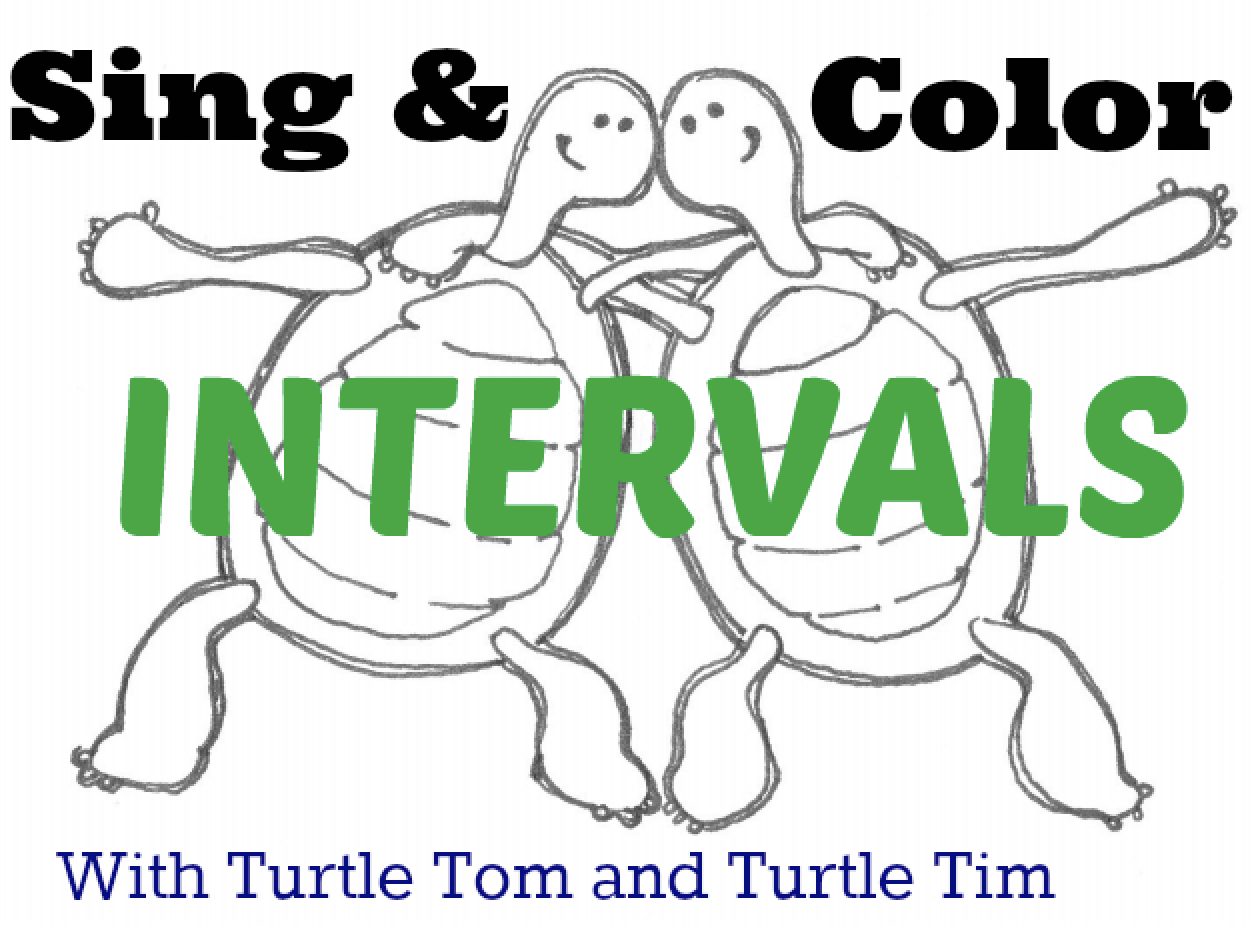
Intervals By Ear: Fun with Turtle Tom and Tim


I love how the ear training components of Let's Play Music lessons train students to hear more in the music they are listening to and understand what they are hearing.  With the better understanding of what's happening in music, students are ready to be expressive (and "musical") in their own composing and playing.  It thrills me to know these skills can be taught- anyone can learn to be musically talented!

A Few Types of Ear Training
Let's Play Music classes incorporate chord training: listening to multiple notes played as triads to make Red, Yellow, and Blue chords that we can use to harmonize songs. But there's more!

What Interval Did You Hear?
Pitch Training refers to hearing and identifying specific notes.  C is always C.  G is always G. When we teach students to sing "Do is Home" or "Middle C" with the pitch of Middle C, with no reference to other notes, they are refining their  absolute pitch.

Interval Training refers to identifying one note based on another note by hearing the distance (interval) between the two pitches.  When students sing or identify specific intervals, they are working on their relative pitch.  I've written about the many reasons learning intervals is so helpful to musicians!

Our second year students are learning about playing intervals with their turtle pals in the song Turtle Shells, so I know they'll be excited for a bit more fun interval ear training with the turtles.

Reference Songs: Interval Training

An easy trick for improving relative pitch is to remember a list of your favorite interval reference songs.  Take the first 2 notes of a song you love, and use those notes as a reminder any time you want to sing that interval. 

Great news! Our students have learned lots of songs in Let's Play Music that will serve as great reference songs when I ask them to sing an interval for me.

Let's go an adventure with Tom and Tim, and sing the intervals!

Major 2nd: Sing the "Do-Re" of a major scale, or sing the first two "up, up" of The Red Balloon song.  Tom and Tim begin their adventure by going to the circus to sing the red balloon song to practice this interval.

Major 3rd: Sing "Do-Mi" of the Red chord, or sing "I Am" (first two notes) from the song How to Skip. Tom and Tim skip rope as they sing these notes.

Major 4th: Sing Do-Fa (or Sol-Do) by remembering "Boom Boom!" from the song Ain't it Great to Be Crazy or sing "Tallest Tree" from the song 5 Fat Turkeys. Tom and Tim's next adventure is to find 5 turkeys in that tree.

Major 5th: Sing Do-Sol, or "Hop Hop" from the ostinato of the song Frog Went A-Hoppin, or sing "Twinkle Twinkle" Little Star. Tom and Tim go to the pond and hop-hop-hop on some lily pads.

Here are two more intervals that we aren't using today, but our students are ready to learn:
Minor 2nd: Sing a major scale and focus on Ti-Do at the end. 
Minor 3rd: Sing Sol-Mi, or Hickety Pickety Bumblebee, a song made entirely of this interval.  In our Sound Beginnings class, we have 2 songs every semester focusing on this important interval, since it's the first one young children can learn and sing back on pitch!

To help my daughter practice and remember these intervals (and because she requested something to color), we made the Adventures of Turtle Tom and Turtle Tim coloring storybook!  

BONUS: The turtles in this story arrange their bodies in the drawings to make each interval (stuck together, stacked up neat, etc.), while singing along to the very song that helps us remember the interval! Can you see how their shells make intervals?

Big Coloring Pages
If you are interested in having pictures to color on two full-sized sheets that are not formatted into a booklet, click HERE.  


MAKE A STORY BOOK BELOW:


Click Image to Download PDF

Assembling your little book:

1. Print the image on 8x11 paper.  Fold along the gray lines, to form 8 sections. Open.
2. Fold in half (short ends together) and cut along the dotted line.  Don't cut too far! 
3. Next, pinch the pages out so the newly-cut seam separates.
4. Adjust the pages nicely so you have a cute little book!  Let your child color and practice singing intervals.

Two Ways to Use The Book

I like to read the story with my daughter, pausing on each page to sing the song.  Then I ask her to sing me just the specified notes (interval) several times.  Then we sing those notes using the solfeg names instead of lyrics several times before going to the next page.

On other days, she has her book in hand, and I play a 'mystery interval' at the piano, or sing it with my voice ("bum-bum").  She flips through her book trying to decide which of the songs I was beginning to sing or play, in other words, she identifies which interval I played!


Wow, Interval Ear-Training Was Easy!
So now you have mastered a few intervals and are off to a great start!  There are a few more to learn (and be sure to recognize and sing them descending as well as ascending), and luckily there are some websites like this and this where you can add more songs and do some drills to get better.  Have fun!

-Gina Weibel, M.S.
Let's Play Music Teacher

Related Posts:
Musical Superpower: Perfect Pitch
Intervals are Worth Knowing