Showing posts with label solfeg. Show all posts

Sunday, July 26, 2015

Solfege: Part 3: Learn the Solfege Hand Shapes

By now you've read the History and invention of solfege as a language of music.  And you've discovered our top seven reasons Solfege works for teaching.  In this Part 3 of our Solfege series, we give you a few tips for learning these hand signs and finding meaning in them!

Help Your Child Learn Solfege
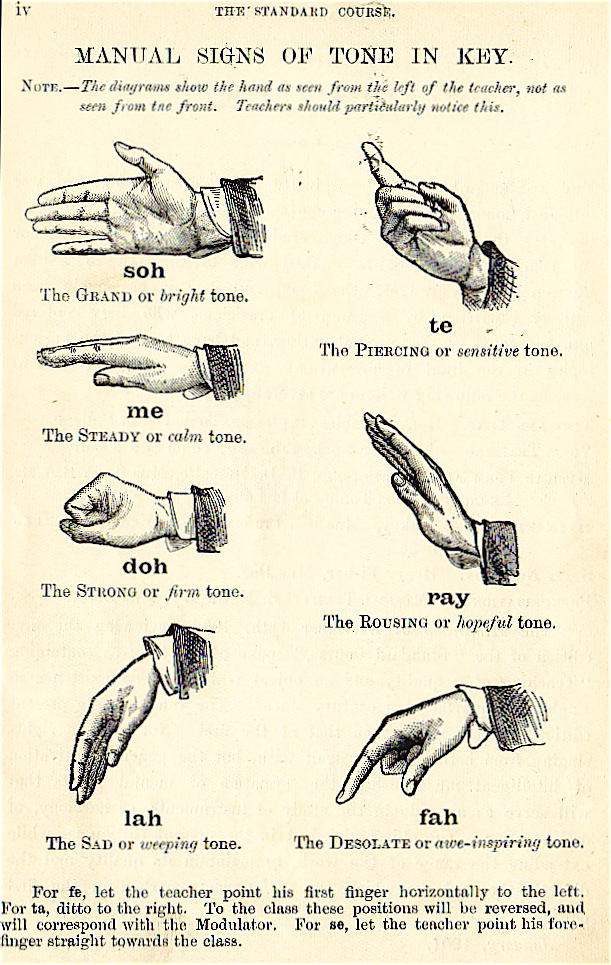
At first encounter, these 7 syllables are nothing more than abstract sounds and hand shapes to be memorized.  Let's Play Music teachers have come up with some handy mnemonics to help your child remember it all, but the good news is that as your child uses this language and internalizes the function, the syllables and handshapes will become meaningful on their own!

Be sure to always use the hand shape with the syllable and the pitch, and with a bit of regular use these will all get neurally linked together and become a fantastic musical tool in your child's toolkit.

Help Me Remember
Below are playful talking points you can use with your child to give the hand shapes additional meaning at first introduction, by relating them to concrete (and silly) ideas kids can make sense of.  After only a few weeks or months, your child will begin to conceptualize each syllable as it's own, real concept, and have no trouble remembering the hand shape.

Each hand shape also has a playful high-five you can give to your child in solfege-style; this gives you yet another great way to say "well done!", practice usage, and keep the mood playful.


DO (the STRONG or FIRM tone, "HOME"): "It looks like your hands are holding onto a rolling pin!  Are you rolling out some DOugh?  Is it pizza dough or maybe cookie dough? Let's pretend to take a bite and taste it!  Yum!"
DO five"Gimme a DO-bump! (or DO-bomb)" Tap knuckles with your child, then open up your hands like they exploded. Make explosion sounds and facial expressions for effect.


RE (the ROUSING or HOPEFUL tone, it easily slides down into DO)"This pointy RE is the tip of my ray-gun!  Watch out or it will zap you."  Use your RE hands to vibrate and zap your child right in the armpit while making a bzzzzt! ray-gun sound. 
Or "It's REining on your head!" Make a RE handshape and set it on your child's head, then slide your hands down her shoulders and wiggle your fingers for a rainy effect.
RE five: "Let's make an X-ray!"  Tip your RE hands forward to touch her RE hands, so it looks like an X and say "X", then tip them upright and say "RE!"


MI (the STEADY or CALM tone)"Who puts their arms flat on the table like this?  ME, of course!"
MI five: Sing on mi pitch as you sing "Give ME a hug!" Hold your hands in MI position, then pull the fingertips apart so you can reach around the child for a hug.


FA (the DESOLATE tone):  Draw a smiley face on your thumbprints and hold them up. Pretend they are walking toward each other.  "Mr. Thumb and his brother went walking along and I told them, 'Be careful or you'll FAAAAAAll down and land on your heads."  Have Mr. Thumbs turn upside down to become FA. This helps students remember to point thumbs down.
FA five: "I have a FA-lower for you!" Either you or your child should make a flower pot by holding a hand in O-shape. Then insert your FA thumb down into the flowerpot, then open the rest of your fingers to make the FA-lower bloom.


SOL (the GRAND or BRIGHT tone): "I ate SOL much DO that now I am SOL full!" Place your SOL hands on your belly to show you're full, or stretch them out with the sol handshape to show how now your belly is "SOL big!".
SOL five:  Most students are already familiar with high fives and low fives, so practice those first.  "Gimme a high-five and a SOL- five, because we don't need a low-five!" Tap the back of your SOL to your child's and vocalize a smacking sound for effect.


LA (the SAD or WEEPING tone): "Now my hands feel so bLAh! My fingers are too bLAh to do anything more than LA."  Emphasize how relaxed and droopy the fingers are as they just hang there. Make a blah face for dramatic effect.
LA five: "Show me your cLAw!" Reach your right LA hand to your child's right LA hand while saying "rowr!" or "meaow!" like a cat or monster with claws, then repeat with the left.  Your child will also laugh if you say "Gimme a LA shake!" and when they hold out their LA hand, you shake it (much like a dead-fish handshake) with a feigned look of repulsion on your face.


TI (the PIERCING or SENSITIVE tone, easily pulls up into DO): "This handsign almost looks like a letter of the alphabet..." Tip your TI fingers to make a letter T and look surprised.  Let your child discover that it looks like 'T'.
TI five: "Make a TI-riangle and I'll give you a tap!" Pretend the child's TI hand shape is a triangle (musical instrument).  Use the triangle mallet or your finger to tap it and vocalize a chiming noise as if you have hit a triangle.  Show the children a triangle to be sure they know what one is!

I hope you have fun playfully helping your child learn these hand shapes.  Just as neurons for the sound, the hand shape, and the syllable are strengthened together during learning,  it will make a big difference if the neurons for happy feelings and having fun are active during your child's learning!

Don't miss the other posts in the series:
SOLFEGE: Part 2: 7 Reasons We Love Solfeg for Teaching Music

SOFEGE: Part 1: When You Know the Notes to Sing...

-Gina Weibel, M.S.
Let's Play Music Teacher

Thursday, July 9, 2015

Solfeg: Part I: When You Know the Notes to Sing...


We just love Solfege.  Perhaps you know it by a different name?  With your best French accent, you might say Solfege.  If you're in Italy, it's Solfeggio.  In England, you might hear it called Solfa, but any way you pronounce it, we're excited about teaching the language of singing and hearing music. 

Ready to become bilingual with your child? Once you speak Solfege, your musical abilities (ahem, superpowers) will amaze and astound.
History of Solfege
Photo credit: Red Poppy Photo and teacher Nicci Lovell
Humans are hardwired to sing and create music.  At a certain point in history, a language was needed to talk about music and notes because musicians started to experiment and become sophisticated with sound. Hey, we invent words whenever we have new ideas, most recently we came up with "blogs" "tweets" and "hashtags".

So now you've sung the Solfege major scale in class (Do Re Mi Fa Sol La Ti Do) and you might wonder why someone would choose such random syllables to be the new words of music . Well, it turns out that if you were at all musical back in the 11th century, then of course you knew the hottest pop song of the time: the chant-like Hymn to St. John the Baptist.  Check out this song (sing along if you like) and pay close attention to the words.  Can you figure out how the solfege syllables were chosen!?


Yes! Strong words in this hymn begin on each note of the major scale, so the first syllable of those words became important; they became the words that represent the notes in the scale!  There is still a little something missing to complete the diatonic scale.  Sancte Iohannes thought about it and added one more syllable, using his initials, and Si was added.  It is possible that Guido of Arezzo (creator of the hymn) and Iohannes were influenced by Eastern musical ideas.  Just take a look at the Arabic alphabet letters Muslims were using to represent notes in their musical system, and you'll see something interesting:

Arabic letters used for singing: ‎ﻡ mīm ﻑ‎ fāʼ ﺹ ṣād ﻝ‎ lām ﺱ‎ sīn ﺩ-‎ dāl ﺭ‎ rāʼ
Solfege used for singing:             mi ---fa ----sol---la -----si --(ut)do ---re 

Rogers and Hammerstein teach solfege in 'Do A Deer'
Right! Did Guido of Arezzo try to make his song fit in with the musical scale (an idea that Rogers and Hammerstein also employed in 'Do A Deer'), or did his random song become the musical scale? If you get a time machine, let me know.

Okay, you might also be asking: what about the Ut? In the 17th century, music scholar Giovanni Battista Doni rightly pointed out that it would be easier to sing if there were an open vowel.  Take a close look at his name…what syllable do you think he suggested? Do!  Or perhaps he, too, was influenced by the Arabic system.

In the 19th century, Sarah Glover suggested that each syllabic 'word' should start with a different letter, so Si was changed to Ti.  So there you have it- words were created and adopted so musicians could work with and communicate about language.

The notes of the solfege major scale today:

Did you wonder if EVERY note on your piano has a solfege word? You know, the chromatic scale, when you play each black and white key on the piano?  The answer is yes! This is the chromatic scale ascending:


And below is the chromatic scale descending.  In Let's Play Music class you'll hear us use me le and te (pronounced 'may' 'lay' and 'tay') when we teach students  to transpose their song into a minor key by finding all of the mi la and tis and lowering them. Re is a funny one, because it already sounds like 'ray', so if we lower it we change it to 'rah'.

Solfeggio in Education
Solfege was brought into prominence in education as researchers discovered the brain’s ability to connect more easily with pitch relationships if a syllable is attached. Solfege gives a name to each step of the scale, so students can learn, for example, the sound ‘MI-SOL’ by singing it (in any key) without having to think about a written note. I am confident that I could sing any note and YOU (after attending first year Let's Play Music) could sing a minor third above or below it, by imagining 'sol-mi' or 'mi-sol'.


Today, solfege is used at most major European and American music schools for training professional musicians. It is the common tongue of all Western musicians, and has many non-Western correspondents as well. 
  
Curwen and Kodály
John Curwen (Britain, 1816-1880) created hand signs for notes, giving us a way to visually and physically represent the function of each note of the major scale. In this way, full body involvement is utilized as the hands ‘feel’ the major scale. While singing in solfeg, the child is producing the pitch with his voice, hearing it with his ear, and reinforcing that pitch relationship with his hands.
The Curwen Hand Signs Adopted By Kodály
Curwen Hand Signs

When signing the solfeg syllables, the hands begin near the waist with DO and rise with each consecutive sign until the octave DO is at a height near your forehead. Hand signs must always communicate pitch height to be completely effective for training the ear.

Zoltan Kodály (Hungary, 1882-1967) was a revolutionist who changed the attitudes of teaching music to children. He incorporated hand signs as a teaching tool.

Another ear training method Kodály promulgated was that of pattern imitation, or patterning.
This is the planned sequence of certain melodic motifs that are presented to the children first in songs, and imitation exercises. Through this presentation, the children would internalize the patterns, which would open the door for them to be identified, labeled, and notated. In this way, Kodály sought to produce children who not only could read music, but who felt it and understood it.

Your Musical Superpower
Hand signs and patterning promote “inner hearing”: a term that Kodály created.
Inner hearing is the ability to hear music in the mind without any music actually being present, and is the precursor to all musical skill.

One of the fundamental inner hearing skills is developing tonal orientation: a feel for the tonal center. Tonal center is the musical “pull” toward the tonic chord and the tonic pitch (DO).  A child who has developed tonal orientation can hear a piece of music in whole or part and accurately decipher where DO is – and can sing it. When this skill is acquired, it is then possible to hear a piece, determine the pitch relationships, and then write down, transpose, or compose a harmony to these notes. 

All Let's Play Music students have the diatonic scale so strongly patterned in their mind's ear that they will intuitively be able to recognize and identify (sing) DO, the tonal center in a piece of music. 

Once the diatonic scale and the diatonic center (DO) are internalized, the ear understands each scale step and can hear pitch relationships (intervals) more easily with practice.  Here is one fun way YOU can start practicing pitch relationships.

By the end of Let's Play Music training, students can sing in tune, hear in tune, and identify if someone else is singing in tune or not (watch out, Mom!).  It is because we have a language for labeling and recalling the pitches and relationships of music that we can easily hold on to sounds in our mind and practice these musical skills.

This is the power of solfeg; and ear training at its finest!
So, let’s start at the very beginning. Let’s use Solfege to develop the inner musician in every child. The sound of DO, the melodic patterns from class, and the pitch relationship exercises students experience now will stay in their aural memory for life!

Continue Reading:
SOLFEGE: Part 2: 7 Reasons We Love It!

SOLFEGE: Part 3: Learn the Handsigns

Tuesday, April 1, 2014

Intervals By Ear: Fun with Turtle Tom and Tim


I love how the ear training components of Let's Play Music lessons train students to hear more in the music they are listening to and understand what they are hearing.  With the better understanding of what's happening in music, students are ready to be expressive (and "musical") in their own composing and playing.  It thrills me to know these skills can be taught- anyone can learn to be musically talented!

A Few Types of Ear Training
Let's Play Music classes incorporate chord training: listening to multiple notes played as triads to make Red, Yellow, and Blue chords that we can use to harmonize songs. But there's more!

What Interval Did You Hear?
Pitch Training refers to hearing and identifying specific notes.  C is always C.  G is always G. When we teach students to sing "Do is Home" or "Middle C" with the pitch of Middle C, with no reference to other notes, they are refining their  absolute pitch.

Interval Training refers to identifying one note based on another note by hearing the distance (interval) between the two pitches.  When students sing or identify specific intervals, they are working on their relative pitch.  I've written about the many reasons learning intervals is so helpful to musicians!

Our second year students are learning about playing intervals with their turtle pals in the song Turtle Shells, so I know they'll be excited for a bit more fun interval ear training with the turtles.

Reference Songs: Interval Training

An easy trick for improving relative pitch is to remember a list of your favorite interval reference songs.  Take the first 2 notes of a song you love, and use those notes as a reminder any time you want to sing that interval. 

Great news! Our students have learned lots of songs in Let's Play Music that will serve as great reference songs when I ask them to sing an interval for me.

Let's go an adventure with Tom and Tim, and sing the intervals!

Major 2nd: Sing the "Do-Re" of a major scale, or sing the first two "up, up" of The Red Balloon song.  Tom and Tim begin their adventure by going to the circus to sing the red balloon song to practice this interval.

Major 3rd: Sing "Do-Mi" of the Red chord, or sing "I Am" (first two notes) from the song How to Skip. Tom and Tim skip rope as they sing these notes.

Major 4th: Sing Do-Fa (or Sol-Do) by remembering "Boom Boom!" from the song Ain't it Great to Be Crazy or sing "Tallest Tree" from the song 5 Fat Turkeys. Tom and Tim's next adventure is to find 5 turkeys in that tree.

Major 5th: Sing Do-Sol, or "Hop Hop" from the ostinato of the song Frog Went A-Hoppin, or sing "Twinkle Twinkle" Little Star. Tom and Tim go to the pond and hop-hop-hop on some lily pads.

Here are two more intervals that we aren't using today, but our students are ready to learn:
Minor 2nd: Sing a major scale and focus on Ti-Do at the end. 
Minor 3rd: Sing Sol-Mi, or Hickety Pickety Bumblebee, a song made entirely of this interval.  In our Sound Beginnings class, we have 2 songs every semester focusing on this important interval, since it's the first one young children can learn and sing back on pitch!

To help my daughter practice and remember these intervals (and because she requested something to color), we made the Adventures of Turtle Tom and Turtle Tim coloring storybook!  

BONUS: The turtles in this story arrange their bodies in the drawings to make each interval (stuck together, stacked up neat, etc.), while singing along to the very song that helps us remember the interval! Can you see how their shells make intervals?

Big Coloring Pages
If you are interested in having pictures to color on two full-sized sheets that are not formatted into a booklet, click HERE.  


MAKE A STORY BOOK BELOW:


Click Image to Download PDF

Assembling your little book:

1. Print the image on 8x11 paper.  Fold along the gray lines, to form 8 sections. Open.
2. Fold in half (short ends together) and cut along the dotted line.  Don't cut too far! 
3. Next, pinch the pages out so the newly-cut seam separates.
4. Adjust the pages nicely so you have a cute little book!  Let your child color and practice singing intervals.

Two Ways to Use The Book

I like to read the story with my daughter, pausing on each page to sing the song.  Then I ask her to sing me just the specified notes (interval) several times.  Then we sing those notes using the solfeg names instead of lyrics several times before going to the next page.

On other days, she has her book in hand, and I play a 'mystery interval' at the piano, or sing it with my voice ("bum-bum").  She flips through her book trying to decide which of the songs I was beginning to sing or play, in other words, she identifies which interval I played!


Wow, Interval Ear-Training Was Easy!
So now you have mastered a few intervals and are off to a great start!  There are a few more to learn (and be sure to recognize and sing them descending as well as ascending), and luckily there are some websites like this and this where you can add more songs and do some drills to get better.  Have fun!

-Gina Weibel, M.S.
Let's Play Music Teacher

Related Posts:
Musical Superpower: Perfect Pitch
Intervals are Worth Knowing


Monday, March 10, 2014

Identifying Minor Sounds is A Majorly Important Skill


Your first-year student has been carefully listening to songs and determining if the tunes sound major or minor.  Hearing and identifying major and minor sounds prepares her to play both types of music on the keyboard next year, transpose between major and minor keys, and write her own composition that may include a minor key!  Her musicianship skills are blossoming!


I've Been to Harlem

This fun folk song gives students a chance to hear the same tune sung major, then again minor for comparison.  Did you know your tone bells give you a chance to explore major and minor at home further?

As you'll remember from our posts on solfeg, DO could be on any note.  With your bells, you can only make a complete major scale if DO is on C, but don't let that stop you from experimenting with assigning other bells to be Do.

Since your student is learning how to skip, have her pull out the C bell, and take a skip, and another to create the Red chord in C Major: CEG or Do-Mi-Sol.  Play this chord and hear that it sounds Major.   Try again starting with the F bell, to create the Red chord in the key of F Major: FAC.  It also sounds Major, and is another Do-Mi-Sol; this time Do was F.

What if you start with D (DFA) or E (EGB)?  This creates a Red chord in the key of D minor and E minor.  Play it with your child and see if she can hear the difference.  The minor triad is Do-Me-Sol, pronounced Doh-MAY-Soh.

With each of those groupings of 3 notes, it was the MIDDLE note that determined that the chord was major or minor. Without the middle bell you can't assign major or minor.

Here's a video of a 4-year-old student creating a few triads, and playing the song "I've Been to Harlem" in C Major and E minor.  (You'll learn a lot more about triads in year 3).  I don't recommend using your feet to hold mallets, nor drinking pickle juice for real.


How did that sound?

Major scales sound brighter and cheerier than the sad (or sleepy or spooky or somber) minor scales.  Nothing beats experience and exposure for helping you learn to recognize the difference between major and minor.  If you want some more practice, here is a short little ear-training quiz with some major and minor chords.  Who got more answers correct, you or your child!?

Teacher Justine Turcott, in Rexburg, ID, shares a conversation between a first-year student and another 4 year-old as they made hot cocoa:

Jaymie: Did you put in enough powder?
Bailey: Yeah.
Jaymie: Well, are you sure? Does it taste Major or Minor?
Bailey: What?
Jaymie: Major is happy and Minor is sad. Does it taste Major?

Here at Let's Play Music, we love to give a multi-sensory approach to learning, and these students found a way to bring the sense of taste into the lesson, too!
  
The Cup Game

The song, "I've Been to Harlem" is also commonly used to play tricky cup rhythm games like this or this.  Part of the fun is having a complex rhythm different from the rhythm of the song lyrics.  I wanted to share the fun of a cup rhythm game with my young family, so we came up with a much simpler routine.

Before singing the song, help your child chant "Beetle, Butterfly, Clap- Pick, Pass" with a cup until she can remember the routine shown in the video below.  The rhythm is beetle-butterfly-beetle-bug.  Ask your child to keep thinking of that rhythm while you sing the song.  Eventually she'll be able to sing along and keep the rhythm going, too.

Here's one Blue Bugs class with Let's Play Music teacher, Robin Flores in Windsor, Colorado playing the cup passing game. You can try it at home, too!


All ages find this game irresistible and will be singing "I've Been to Harlem" and requesting more chances to play the cup game!  They laugh when they make a mistake and feel exhilarated when it works out.

I hope you find some time to extend your fun with "Harlem" and get more exposure to major and minor sounds this month.

- Gina Weibel, M.S.
Let's Play Music Teacher

Thursday, November 14, 2013

Solfege: Part 2 : 7 Reasons We Love It!

We recently posted Part 1 of our Solfege series: all about the history of solfeg and its usefulness in ear training.  Today I'll share 7 more reasons Let's Play Music teachers use solfege and LOVE IT!


1. There's a Word for That
Can you imagine teaching your child to identify colors without having any color words?  Not easy!  Similarly, as students learn to discern pitches and intervals between pitches, using a system  for putting a name to the pitches (solmization) facilitates the process immensely.  China, Japan, Korea, India, and Indonesia all have solmization schemes for associating pitch to a name.  When talking about fixed pitches, we use the alphabet (C is always C) and when talking about scales and relationships between notes in a scale, we use solfeg!

2. Whole-Body Involvement
Each of our young students (and even many of our toddler Sound Beginnings students) master the  hand signs and use them to experience singing, ear-training, and note-reading with their whole body.  As they hear the pitches moving up and down, their hands move up and down through space accordingly.  As they recognize intervals and relationships between the notes, they can feel the distance of jumps between pitches and grasp them with their hands.

Adding this kinesthetic mode of learning to an auditory and visual skill heightens a child's absorption of the information, accommodates various learning styles, and facilitates integration and long-term learning.  Solfeg is a popular tool for University students majoring in music fields;  it should be shared with young children, too, who adore and quickly internalize having a physical movement to put with their singing.  You already knew wiggly, active children enjoy having actions to accompany their favorite nursery songs, right?  If there's a way to make teaching more physical AND more fun for them, let's do it!

 3. Understanding Scales and Key Signatures
Would you love to be able to quickly and easily sing every major scale?  You can do it today! You don't have to memorize the notes of every single scale, just memorize the 7 solfeg syllables and start singing on whichever pitch you wish to be DO.  That's part of the power of the moveable DO  (read more here): the relationships within each scale will remain the same.

'Do' corresponds with the tonic of whatever key a particular composition or melody is placed. Thus in the Key of C major, C is Do, and in the Key of F major, F is Do.  You can see those two scales already engraved on your Let's Play Music tone bells!  Truly, any bell or piano key could be Do.  Of course you'd have to add some black keys to your scale to get it to sound like a major scale, but now after a few months of Let's Play Music training, your child could pick out (by ear) which black keys were needed.

Do is the note that the music rotates around and pivots back to. Whatever key we sing in, Do really is home!  Most songs end by bringing the melody back to Do.


4. Intervals
We recently posted about the powerful ways that mastering intervals will help you improve musicianship in your reading, singing, and composing music.

Solfeg is a handy tool for students wishing to master interval training.  The goal is to instantaneously recognize the precise intervals when heard, and having solfeg words to identify them is very helpful in this process.  "The notes I just heard sounded like...Do-Fa! It's a 4th!"

Here are just a few relationships I am confident my Let's Play Music students can hear and identify:
Do - Re : major 2nd 
Do - Mi : major 3rd 
Do - Fa: perfect 4th
Do - Sol: perfect 5th
Mi - Sol: minor 3rd  
In class we sing this as Sol-Mi more often than as Mi-Sol, but they are the same interval, of course.

5. Sight Reading Music
Choir class is a very common place to find solfeg at work; students are taught to rely on solfege for sight-singing melodies.  Singers can quickly read and sing the written melody if they interpret it in terms of solfege because they have learned the relationships between each solfege note and don't need to be retaught those relationships for whatever key the music is written in.

Here are some videos of choir students performing 4-part vocal music they have never rehearsed, using solfeg syllables and hand signs. In the 3rd year of Let's Play Music, your teacher will use her hands to show signs for the students to 'sight sing'.


At the piano, sight-reading music in the same way and hearing it with our inner voice helps us to self-correct as we play.  Solfege allows us to be able to play a tune in another key (transpose) by choosing a new DO and playing the same solfeg pattern (see an example here.)  We will practice singing and transposing this way in Purple and Orange semesters!


6. Sharps, Flats and Minor Keys
Now that we know having a way to sing the steps of a scale makes it easier to learn music, some folks have wondered why we don't prefer to sing numbered steps (1,2,3,4,5,6,7) instead of the solfeg syllables.  The word 'seven' is already less-than-popular because it is not a monosyllable, but all of the numbers become problematic if we ever want to introduce sharps or flats.  'Raised-seven' is definitely not an easy-to-sing monosyllable!

With solfeg, for a note that is lowered a half-step, we sing it with an A sound (like in the word "nay") but spell it with an e. Thus mi becomes me (may), la becomes le (lay), ti becomes te (tay), etc. This works for all scale steps except re which is already an e sound, so re lowered a half-step become ra (rah!).

For a note that is raised a half-step, we sing it with an ee sound, but spell it with an i. Thus, fa becomes fi. This works for all steps except mi and ti, but they are almost never raised anyway. 

Here are the syllables for the chromatic scales (play every single key on your piano, both black and white, as you sing):
ascending: do di re ri mi fa fi sol si la li ti do
descending: do ti te la le sol se fa mi me re ra do

In Let's Play Music class, we won't spend much time teaching all of the raised and lowered syllables, but it is a beautiful and simple system to grow into as your child takes interest in further musical skills.  Each year I have one or two Orange students wanting to compose in minor keys, and I do help them master me, le, and te so they can be sure to write an appropriately minor melody.

7. Solfeg Works
The final, and perhaps best, reason I want to share about why Let's Play Music teachers love solfege is simply that it works.  Students wanting to become better musicians (and get passing-grades in their college-level music classes) find that having the right tools will get the job done.  There's no need to wait until college; solfege can help your very young child improve musicianship right now.  Understanding, internalizing, and using solfege will lead you and your child to be bilingual: you speak the language of music!

Be sure to read SOLFEGE: PART 1: When You Know the Notes To Sing...
and SOLFEGE PART 3: Learn the Hand Signs

- Gina Weibel, MS
Let's Play Music Teacher