
Showing posts with label intervals. Show all posts

Tuesday, April 1, 2014

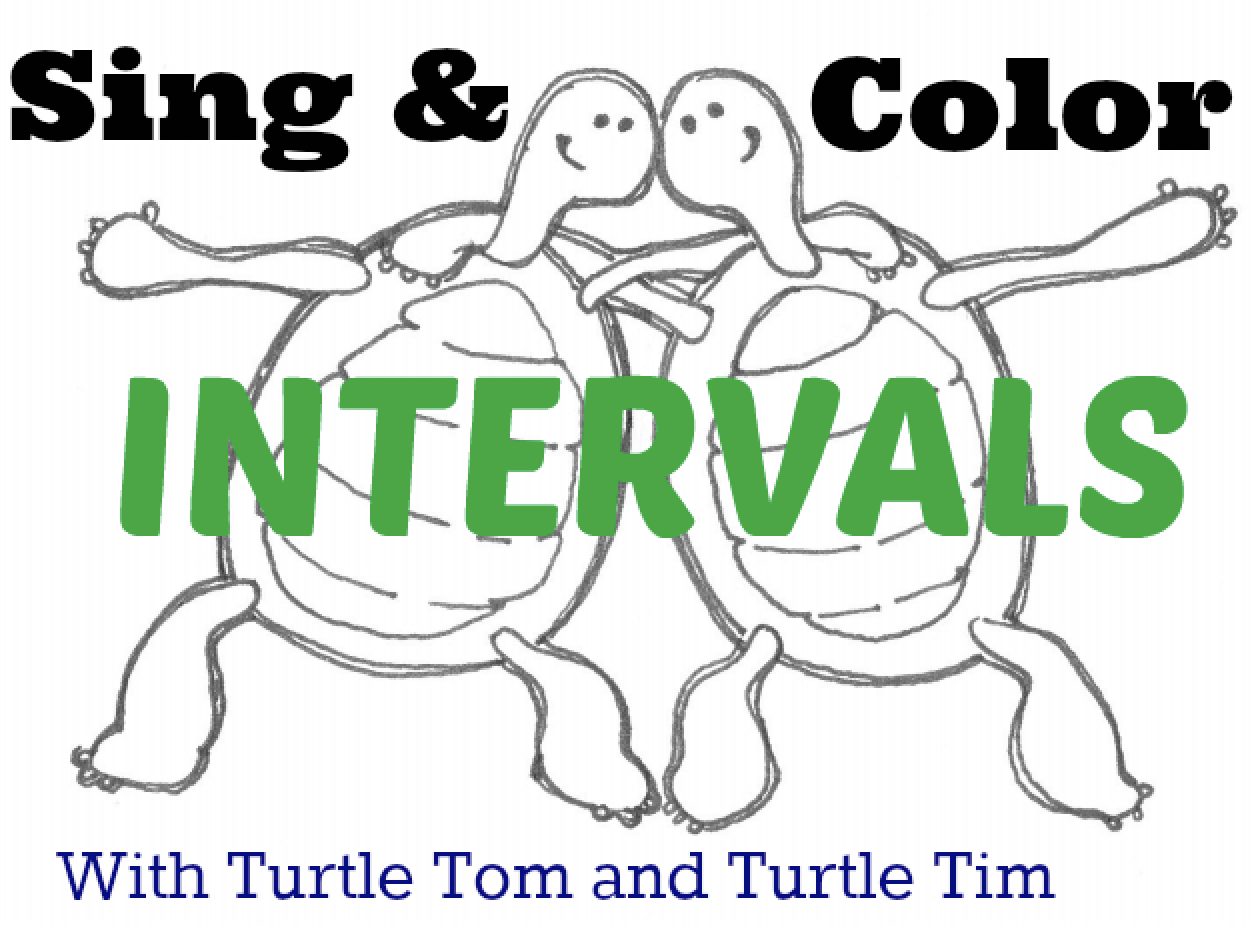
Intervals By Ear: Fun with Turtle Tom and Tim


I love how the ear training components of Let's Play Music lessons train students to hear more in the music they are listening to and understand what they are hearing.  With the better understanding of what's happening in music, students are ready to be expressive (and "musical") in their own composing and playing.  It thrills me to know these skills can be taught- anyone can learn to be musically talented!

A Few Types of Ear Training
Let's Play Music classes incorporate chord training: listening to multiple notes played as triads to make Red, Yellow, and Blue chords that we can use to harmonize songs. But there's more!

What Interval Did You Hear?
Pitch Training refers to hearing and identifying specific notes.  C is always C.  G is always G. When we teach students to sing "Do is Home" or "Middle C" with the pitch of Middle C, with no reference to other notes, they are refining their  absolute pitch.

Interval Training refers to identifying one note based on another note by hearing the distance (interval) between the two pitches.  When students sing or identify specific intervals, they are working on their relative pitch.  I've written about the many reasons learning intervals is so helpful to musicians!

Our second year students are learning about playing intervals with their turtle pals in the song Turtle Shells, so I know they'll be excited for a bit more fun interval ear training with the turtles.

Reference Songs: Interval Training

An easy trick for improving relative pitch is to remember a list of your favorite interval reference songs.  Take the first 2 notes of a song you love, and use those notes as a reminder any time you want to sing that interval. 

Great news! Our students have learned lots of songs in Let's Play Music that will serve as great reference songs when I ask them to sing an interval for me.

Let's go an adventure with Tom and Tim, and sing the intervals!

Major 2nd: Sing the "Do-Re" of a major scale, or sing the first two "up, up" of The Red Balloon song.  Tom and Tim begin their adventure by going to the circus to sing the red balloon song to practice this interval.

Major 3rd: Sing "Do-Mi" of the Red chord, or sing "I Am" (first two notes) from the song How to Skip. Tom and Tim skip rope as they sing these notes.

Major 4th: Sing Do-Fa (or Sol-Do) by remembering "Boom Boom!" from the song Ain't it Great to Be Crazy or sing "Tallest Tree" from the song 5 Fat Turkeys. Tom and Tim's next adventure is to find 5 turkeys in that tree.

Major 5th: Sing Do-Sol, or "Hop Hop" from the ostinato of the song Frog Went A-Hoppin, or sing "Twinkle Twinkle" Little Star. Tom and Tim go to the pond and hop-hop-hop on some lily pads.

Here are two more intervals that we aren't using today, but our students are ready to learn:
Minor 2nd: Sing a major scale and focus on Ti-Do at the end. 
Minor 3rd: Sing Sol-Mi, or Hickety Pickety Bumblebee, a song made entirely of this interval.  In our Sound Beginnings class, we have 2 songs every semester focusing on this important interval, since it's the first one young children can learn and sing back on pitch!

To help my daughter practice and remember these intervals (and because she requested something to color), we made the Adventures of Turtle Tom and Turtle Tim coloring storybook!  

BONUS: The turtles in this story arrange their bodies in the drawings to make each interval (stuck together, stacked up neat, etc.), while singing along to the very song that helps us remember the interval! Can you see how their shells make intervals?

Big Coloring Pages
If you are interested in having pictures to color on two full-sized sheets that are not formatted into a booklet, click HERE.  


MAKE A STORY BOOK BELOW:


Click Image to Download PDF

Assembling your little book:

1. Print the image on 8x11 paper.  Fold along the gray lines, to form 8 sections. Open.
2. Fold in half (short ends together) and cut along the dotted line.  Don't cut too far! 
3. Next, pinch the pages out so the newly-cut seam separates.
4. Adjust the pages nicely so you have a cute little book!  Let your child color and practice singing intervals.

Two Ways to Use The Book

I like to read the story with my daughter, pausing on each page to sing the song.  Then I ask her to sing me just the specified notes (interval) several times.  Then we sing those notes using the solfeg names instead of lyrics several times before going to the next page.

On other days, she has her book in hand, and I play a 'mystery interval' at the piano, or sing it with my voice ("bum-bum").  She flips through her book trying to decide which of the songs I was beginning to sing or play, in other words, she identifies which interval I played!


Wow, Interval Ear-Training Was Easy!
So now you have mastered a few intervals and are off to a great start!  There are a few more to learn (and be sure to recognize and sing them descending as well as ascending), and luckily there are some websites like this and this where you can add more songs and do some drills to get better.  Have fun!

-Gina Weibel, M.S.
Let's Play Music Teacher

Related Posts:
Musical Superpower: Perfect Pitch
Intervals are Worth Knowing


Thursday, November 14, 2013

Solfege: Part 2 : 7 Reasons We Love It!

We recently posted Part 1 of our Solfege series: all about the history of solfeg and its usefulness in ear training.  Today I'll share 7 more reasons Let's Play Music teachers use solfege and LOVE IT!


1. There's a Word for That
Can you imagine teaching your child to identify colors without having any color words?  Not easy!  Similarly, as students learn to discern pitches and intervals between pitches, using a system  for putting a name to the pitches (solmization) facilitates the process immensely.  China, Japan, Korea, India, and Indonesia all have solmization schemes for associating pitch to a name.  When talking about fixed pitches, we use the alphabet (C is always C) and when talking about scales and relationships between notes in a scale, we use solfeg!

2. Whole-Body Involvement
Each of our young students (and even many of our toddler Sound Beginnings students) master the  hand signs and use them to experience singing, ear-training, and note-reading with their whole body.  As they hear the pitches moving up and down, their hands move up and down through space accordingly.  As they recognize intervals and relationships between the notes, they can feel the distance of jumps between pitches and grasp them with their hands.

Adding this kinesthetic mode of learning to an auditory and visual skill heightens a child's absorption of the information, accommodates various learning styles, and facilitates integration and long-term learning.  Solfeg is a popular tool for University students majoring in music fields;  it should be shared with young children, too, who adore and quickly internalize having a physical movement to put with their singing.  You already knew wiggly, active children enjoy having actions to accompany their favorite nursery songs, right?  If there's a way to make teaching more physical AND more fun for them, let's do it!

 3. Understanding Scales and Key Signatures
Would you love to be able to quickly and easily sing every major scale?  You can do it today! You don't have to memorize the notes of every single scale, just memorize the 7 solfeg syllables and start singing on whichever pitch you wish to be DO.  That's part of the power of the moveable DO  (read more here): the relationships within each scale will remain the same.

'Do' corresponds with the tonic of whatever key a particular composition or melody is placed. Thus in the Key of C major, C is Do, and in the Key of F major, F is Do.  You can see those two scales already engraved on your Let's Play Music tone bells!  Truly, any bell or piano key could be Do.  Of course you'd have to add some black keys to your scale to get it to sound like a major scale, but now after a few months of Let's Play Music training, your child could pick out (by ear) which black keys were needed.

Do is the note that the music rotates around and pivots back to. Whatever key we sing in, Do really is home!  Most songs end by bringing the melody back to Do.


4. Intervals
We recently posted about the powerful ways that mastering intervals will help you improve musicianship in your reading, singing, and composing music.

Solfeg is a handy tool for students wishing to master interval training.  The goal is to instantaneously recognize the precise intervals when heard, and having solfeg words to identify them is very helpful in this process.  "The notes I just heard sounded like...Do-Fa! It's a 4th!"

Here are just a few relationships I am confident my Let's Play Music students can hear and identify:
Do - Re : major 2nd 
Do - Mi : major 3rd 
Do - Fa: perfect 4th
Do - Sol: perfect 5th
Mi - Sol: minor 3rd  
In class we sing this as Sol-Mi more often than as Mi-Sol, but they are the same interval, of course.

5. Sight Reading Music
Choir class is a very common place to find solfeg at work; students are taught to rely on solfege for sight-singing melodies.  Singers can quickly read and sing the written melody if they interpret it in terms of solfege because they have learned the relationships between each solfege note and don't need to be retaught those relationships for whatever key the music is written in.

Here are some videos of choir students performing 4-part vocal music they have never rehearsed, using solfeg syllables and hand signs. In the 3rd year of Let's Play Music, your teacher will use her hands to show signs for the students to 'sight sing'.


At the piano, sight-reading music in the same way and hearing it with our inner voice helps us to self-correct as we play.  Solfege allows us to be able to play a tune in another key (transpose) by choosing a new DO and playing the same solfeg pattern (see an example here.)  We will practice singing and transposing this way in Purple and Orange semesters!


6. Sharps, Flats and Minor Keys
Now that we know having a way to sing the steps of a scale makes it easier to learn music, some folks have wondered why we don't prefer to sing numbered steps (1,2,3,4,5,6,7) instead of the solfeg syllables.  The word 'seven' is already less-than-popular because it is not a monosyllable, but all of the numbers become problematic if we ever want to introduce sharps or flats.  'Raised-seven' is definitely not an easy-to-sing monosyllable!

With solfeg, for a note that is lowered a half-step, we sing it with an A sound (like in the word "nay") but spell it with an e. Thus mi becomes me (may), la becomes le (lay), ti becomes te (tay), etc. This works for all scale steps except re which is already an e sound, so re lowered a half-step become ra (rah!).

For a note that is raised a half-step, we sing it with an ee sound, but spell it with an i. Thus, fa becomes fi. This works for all steps except mi and ti, but they are almost never raised anyway. 

Here are the syllables for the chromatic scales (play every single key on your piano, both black and white, as you sing):
ascending: do di re ri mi fa fi sol si la li ti do
descending: do ti te la le sol se fa mi me re ra do

In Let's Play Music class, we won't spend much time teaching all of the raised and lowered syllables, but it is a beautiful and simple system to grow into as your child takes interest in further musical skills.  Each year I have one or two Orange students wanting to compose in minor keys, and I do help them master me, le, and te so they can be sure to write an appropriately minor melody.

7. Solfeg Works
The final, and perhaps best, reason I want to share about why Let's Play Music teachers love solfege is simply that it works.  Students wanting to become better musicians (and get passing-grades in their college-level music classes) find that having the right tools will get the job done.  There's no need to wait until college; solfege can help your very young child improve musicianship right now.  Understanding, internalizing, and using solfege will lead you and your child to be bilingual: you speak the language of music!

Be sure to read SOLFEGE: PART 1: When You Know the Notes To Sing...
and SOLFEGE PART 3: Learn the Hand Signs

- Gina Weibel, MS
Let's Play Music Teacher

Friday, September 20, 2013

Intervals are Worth Knowing


If you're in the second year of Let's Play Music, you're about to get to know intervals very well. This student demonstrates how his hands can create the intervals from our Turtle Shells song:


in·ter·val /ˈintərvəl/  - the difference in pitch between two notes


Soon your student will reliably identify the sight and sound of harmonic intervals: two notes played at the same time, thanks to our turtle shells.
  
Astute students will also realize that melodies are made of up melodic intervals: notes played one after the other.  That's right...a baby step is a melodic second and a skip is a melodic third.


So, why the big emphasis on intervals?  Here are a few good reasons you'll be glad to hear, "My intervals: I know them very well!"

Music Reading

You may have heard that it deosn't mttaer in waht oredr the ltteers in a wrod are, the olny iprmoatnt tihng is taht the frist and lsat ltteers be at the rghit pclae.  That's not exactly true, but the take-home message is that humans read words in chunks, not letter-by-letter, and the parallel is true for music.

In the 3rd year of Let's Play Music, your child will learn how to read and play every note from the staff, but playing note-by-note through every song would be slow and laborious.  

Musicians can learn to read music with ease and fluidity (remember how many hours of practice it took to read storybooks with ease and fluidity?), but they don't do it by thinking of each note as an 'A' or a 'G'.  They use intervals and chord shapes to quickly interpret music.

You've seen this on the bells in the first year classes: once the first note is identified, the melody can be quickly read by considering steps and skips up and down the staff.  Likewise, with  practice, your student can use intervals, scales and chord shapes to read chunks of notes with two part or thicker textures moving independently throughout a piece of piano music.

Singing

Sight-singers interpret written music and audiate the melodic intervals. We can test what someone is audiating by asking her to sing what she's thinking. Since there's no other way to test what a student is hearing in her mind, we always practice the skill of audiating intervals and the skill of singing intervals together.

In class we sing each interval to practice accurately jumping our voices to each pitch. Have you sung and signed this melodic interval activity in class?
Do-Re-Do.
Do-Mi-Do.
Do-Fa-Do.
Do-Sol-Do.
Do-La-Do.
Do-Ti-Do
Do- DO- Do!

Another way to train yourself to accurately sing intervals is to choose a reference song for each (2nd, 3rd, 4th, 5th). This post has a fun turtle coloring book helping you practice singing each interval.
  
Hearing harmonic intervals enables singers to harmonize a part in a choir, unlocking the joys of singing with friends and choir ensembles.

Composing

Have you ever had a little tune playing in your mind?  Would you love to jot it down and flesh it out into a complete composition?  

A first step is to follow that melody interval-by-interval to discover the notes. The more you practice this game at the keyboard, the better you get. Pick a starting pitch, and play a song you know by hearing and sensing how far to jump up or down to the next note! You'll be a genius at playing by ear if you play this game frequently.
  
Next, add some red, yellow, and blue chords for harmonization with your melody, and you'll be well on your way to creating an excellent composition like the 3rd year Let's Play Music students do.

So keep up the ear-training to identify those intervals, because, "that's the nicest sound I've ever heard!"

-Gina Weibel, M.S.
Let's Play Music Teacher