Showing posts with label music reading. Show all posts

Wednesday, May 2, 2018

Writing is Fundamental.

Music is a Language. We Must Read AND Write.

Imagine the following scenario: a 17-year old with straight A's is ready to graduate from high school.  

You hand her a difficult piece of prose to read, which she does well. 

Next, you ask to write something original in the next 5 minutes--a short essay on something of her choice.  She stares blankly, then says "I've never written anything before."

"OK," you say. "Well, I'll tell you a sentence or two, and you can write that down."

You are met with a stare again as she says, "I can't do that."

We'd be shocked if someone could graduate high school without ever having written anything before, or even being able to write down what someone says.

But, in music, we're guilty of this ALL THE TIME.

What's up with Writing Music?

People with many years of lessons under their belts can read music fluently, but often have never written a note on paper, and can't even begin to write down the music they hear.  

In fact, I wonder whether a person ever actually does learn to read ANY language fluently if they don't have experience writing words and connecting the written word to the spoken one.  We begin teaching this skill to students in preschool who are mastering English. 

We might ask if a student, like the high school student in the story above, even has a real understanding of the music she plays.  Or, is she like the allegory of a monkey who can type Portugese--a monkey can be trained to look at the symbols and push the corresponding buttons on the typewriter but has no understanding of the meaning of what she types.

Sadly, there are too many music students who are like this.

How do we Train Musicians, not Typists?

We can overcome the weak trend in music education. It starts with having students write music.  

Just this week, one of my younger students, who is starting her third year of piano, started writing a short piece.  When she started to write middle C, I pointed out that what she was playing was in fact a C but one octave higher, and should be written as such.

She exclaimed, "Oh! That's why that C is at the third space!"  And this was a student who has been reading and playing notes for 2 years and doing well for her age.  The exercise of doing it the opposite way-- when you can see the keyboard and the note you want, and you can hear it, and then you have to figure out how to write it on the staff-- this registers differently in the brain. It registers is a way that is likely to stick and reinforce what we're teaching.

Better Writers = Better Performers


Not every studio teacher will be comfortable or experienced in helping students write their own original music.  Even allowing the space and time for students to do this for a few minutes' of lesson time can have great benefits and help them accelerate ALL of their learning and musicianship.

I know when I began to compose, I found it not only fun and fulfilling, but the exercise made me a much better performer because I saw everything-- dynamics, phrase marks, articulations, repetitions-- in a new light.  

I knew, then, exactly why a composer would put those symbols in because I had put those same symbols in my music to gain a desired result.

Shall we Transcribe?

Even if the activity isn't truly composition, great results can be had from transcribing an easy piece or folk song. This can actually be a very effective way to help students learn key signatures: transcribing simple songs in keys with three or four sharps or flats to help students internalize what the key signature really means and why it is so important.

Similar results can be had in the domain of rhythm. Most students, even at a beginning level can quickly develop a good sense of rhythm by clapping and tapping along with their favorite songs.  Converting that clapping to written symbols is difficult for many students (and teachers). 

Of course, doing drills and working on the reading aspect will help, but don't overlook simply taking a student's favorite song and having them try to write out the rhythm themselves. 

I know this can be time-consuming and it is tempting to think, "I don't have time for that!"  But it has been my experience that an hour or two devoted to doing this for even a few bars of a couple of songs comes back with many returns in the form of much quicker learning through rhythms in every piece a student attempts after having done it. 

Learn By Doing it YOUR Way

Composing and transcribing is fun! All students, but especially kids of this generation, want to do things their own way.  They enjoy being creative, whether that's in the form of improvisation or creating their own music or arranging their own way of playing a popular song.

Students will enjoy lessons more and internalize more if they're creating their own way to play something they like.

One of my favorite things about Let's Play Music is that it gets students writing and allows them to finish the curriculum with a short piece they invented themselves.  

All of us who help these students continue their studies, and especially those of us who have students who have never written music themselves, must take every opportunity to get students putting the music they make, see, hear, and play down on the page themselves.

The rewards are always worth the time spent to both students and teachers.


- Dr. Kris Maloy is an award-winning composer, arranger, and performer. He has served as a professor at several different universities and taught students of all ages through Gold Lantern Music, the studio he founded in Fort Collins, CO.

In Spring 2018, we are happy to have Dr. Maloy as a guest judge for our own Let's Play Music composers.  We have over 1500 3rd-year students in the USA and Canada, and each of them has written an original piece of music before graduating from our program. And, we are happy to tell Dr. Maloy, they still have ten years before they get to graduation.


Saturday, August 26, 2017

Oh No! My Child Is Playing By Ear!


In the 2nd and 3rd year of Let's Play Music, students play and pass off dozens of repertoire pieces. During some daily practice, you'll likely have the experience of noticing, "Hey! She's not reading the music!"  You might feel a impressed, then a bit worried.

Is She Even Reading the Music??

In Let's Play Music, we train those little ears so incredibly well that most students become great at playing by ear.  They hear the song a few times, and they've got it! It's easy to accidentally forget to train the eyes, too.

Every student has strengths; some rely heavily on their ear skills and others are more visual learners.  Whichever type of learner you have, there are things you can do to bolster their skill in reading notation. 

How We Teach Music Notation

Just as a reminder, this is how we teach music notation (full post) in Let's Play Music:

1. Expose students to lots of simple tunes: so they can find meaning in what they decode. It's fun to realize you're reading something familiar.

2. Show how notes work: up, down, step, skip. Bells an keyboards are the best for teaching since each note has one definite physical bell corresponding.

3. Learn common patterns: quickly recognizing common patterns and chords is similar to quickly recognizing sight words. You can read faster because you recognize these melodies and chords at a glance.

4. Read anchor notes: Middle C, treble C, bass C and a handful of others are the first notes students can read, then go find on the keyboard. Starting from an anchor note, they can read the rest of the song with skips/steps.

5. Find any note: that's note-spelling. Musicians don't read a whole song that way, but at the beginning of each phrase or chunk, we check to make sure we're starting on the right note.

6. Start with success: Reading chords and reading familiar tunes means they will sound awesome from day one. It's very motivating.

7. In loving arms: The emotional atmosphere of our teaching has a big impact on how well children learn!

Don't Look at Your Hands

Sometimes in class we encourage students to look at their hands when teaching keyboard geography or tricky fingering.  Looking at the keys as she hears the sound they make also strengthens neural connections between those keys and the way they sound.  Looking at hands is not all bad!

But, looking at hands excludes the student from looking at notes, a skill necessary for note reading. It also means the student is linking their proprioceptive skill (ability to move body parts and know where they are in space) with visual input-- a habit we want to break.  

Don't worry, she learned to walk without looking at her feet. Eventually she can play without looking at her fingers.  

A gentle way to strengthen proprioceptive skill is to have her put her bubble-shaped hands gently on top of her head (so she can't see her fingers), then sing the bubble hand song so she'll tap the fingers without looking at them.

Covering hands by hovering a book or sheet of paper a few inches above is perhaps the best way to break a habit of looking down instead of up, but can be scary for nervous students.  At first it will be challenging and the student won't look at anything.  She'll be imagining her hands and visualizing the fingers moving.  Once she can move her fingers without needing to visually imagine it, her eyes and brain will be available to look up at the notes as she plays them.

Whenever possible, remind your child with a "DO" action instead of a "DON'T" action.  "Don't look at your hands" leaves a child with a few steps of interpretation...what should I do!?  Instead, remind "Keep your eyes up on the notes."

Matching Eyes to Ears

A big part of reading is wiring the brain to recognize that the written notes correspond to the sound coming from the keys.  Even if your child is already playing a song perfectly, it is still very valuable to follow the notes visually as they are being played.

A parent can sit next to the child and point a finger or pencil at each note as the student plays it.  

I recommend sitting on the child's LEFT SIDE so that your arm is not blocking notes to come- we want her to be able to see what's coming in her peripheral vision and start processing it before she even gets there.


A slightly more complex way of pointing is the V-Fingers. Hold your left hand in a "peace" sign and tip sideways. Now one finger points at the treble clef while another finger points at the bass clef, sliding your < left-to-right as the music plays.  This is a good way to point to music when students need to match up two-hand playing and time them correctly.


Another game for matching eyes to ears is laser beam eyes.  Tell your child to imagine lasers coming out of her eyes.  She can shine a laser onto each note as she reads it.  Only when the eye-laser is shining on a note AND the note is sounded will it explode and she can move on to the next one. It's like playing the game ASTEROIDS.  As she plays, watch her eyes to make sure they stay on the book, going note-to-note.


Books On Tape, PBJ Sandwiches

Now let's get to the crux of reading music.  Your child might have perfect laser-beam eyes AND play the song perfectly but still not prove that she's reading. What?!

If she can play the song by ear, having her look at the notes is parallel to enjoying books on tape and following along with a print copy.  You're looking at the words and you're hearing the words, which is helpful for learning to read, but you're not forced to decode the words.

Is it really surprising that kids 'cheat' on reading if they think they don't need to?

Imagine that I show you once or twice how I make a peanut butter sandwich.  Then I show you a printed step-by-step procedure and tell you it's your turn to make a sandwich. With a huge eyeroll you *completely* ignore my instructions and swiftly create a really tasty sandwich.  For some inexplicable reason, I'm shaking my head and complaining,  "you didn't even look at my instructions!" 

You're thinking, "Crazy lady, I can make a perfectly good sandwich without instructions."  Our awesome musicians are like you, awesome parent who cooks food. They CAN make great music without bossy instructions.

So, next time I take you in the kitchen, I hand you a new recipe.  "Today you can make my gourmet DoReMi casserole that you've never had before. It won't  DoReMi casserole unless you include all of the secret ingredients, so be sure to get them all."

THIS time are you motivated to read my recipe?  Those very strong ear students are the same way.  By providing them something novel and surprising and including elements of a game (did you notice where the melody had a tricky change?) they will be motivated to practice reading skills.  They cannot rely on the ear because they've never heard this new thing before.

Find Sightreading Material

Sight-reading is looking at notes, decoding, and understanding how to execute on the keyboard.

Even better: looking, decoding, and hearing in the mind, then executing. When sight-reading is most proficient, students are STILL playing by ear, right? 

I love my strong ear students because I feel like they are going to be some of the most gifted readers if I can just get them to want to eat casserole.  You know what I mean.

Not all kids and parents want more to do at home, but if you have a strong-ear child who could benefit from sight-reading exercise, you can provide new music notation that she hasn't seen, and likely only plays a few times. A constant, steady supply of new notation will do the trick.

I always give students sight-reading material that is a few levels easier than what they play for repertoire.  It is either simpler music, or I let them play just one hand, or let them play at a slow pace.  The material must be easy because I expect them to get it correct (or 99%) on the first try!

In class, Edna and Edison (those lovable puppets!) play sight-reading games with students, but maybe you need more.


  • Songbook Snippets: Yes, your child can play everything in the songbook. BUT! If you pick a measure in the middle of a song and ask her to begin there... wow, it's suddenly sight-reading!  Jump through the book and play 2-3 measures of snippets.  Have a parent or sibling listening nearby see if they can guess which song is being played. Songbook snippets may be all you need to get your sight-reading boost.
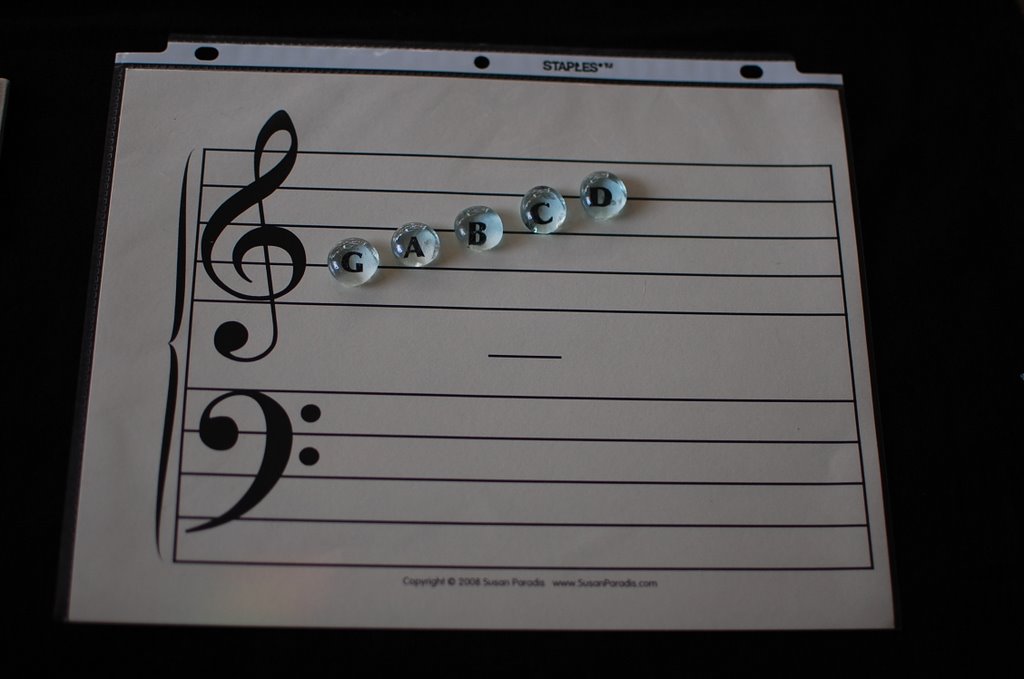
  • Songbook Staff: In the back of your book is a staff. Here's another copy (LINK) that you can laminate and write on with EXPO markers. Anyone can write some notes! Write a few and say "I wonder if this will be an interesting tune? Let's find out!" then have your child play it to see.  Erase and repeat a few times for each practice. Tips: Start with an anchor note your child can find. Move with steps and skips up and down. Include chords and intervals she knows.
  • Teachers are genius at jotting out quick melodies. If you are struggling to come up with some, you could talk to your teacher and see if she's willing to write a couple to get you started, either on your laminated card or on a strip of paper.
  • Purchase items for sight-reading like this book on Amazon, or these flash cards. This Dozen a Day series provides technical drills, but they are also great for sight-reading steps and skips. If she plays a different one each day, she will really have to read. 
  • Recycle If you are in a musical home, you may already have some very easy piano sheet music, or might be able to pick some up at a thrift shop. Have your child play those tunes. Start with just one hand, or just snippets of tunes.  Just a 2 minutes of practice each day on reading can make a difference.
Skills Take Time

During the few minutes each day that you decide to work on just reading, remind your child that TEMPO can be slow. The goal of the game is to play the notes and rhythms correctly.  

Help keep sight-reading fun by presenting it as a game:
"I wonder what the composer is trying to say to us? Let's see if you can read his message."  "You did it! You solved the mystery!"

Eventually tie sight-reading and listening together. After playing a line of notes for the first time, ask your child to sing it.  Can she remember what she just played?  

Don't worry if she can't yet.  Beginning readers have the same struggle- they'll read a line of text successfully, "The dog jumped into the big old bag" but then can't repeat the sentence back...they were so focused on decoding that the meaning didn't sink in yet!  Over time, your child WILL be able to read and find meaning.

That's when you know it's time to introduce slightly more difficult music for sight-reading :)

Sight-reading is a skill that takes practice and focus to learn.  Since your child is already showing great progress with ear training, I'm confident that she will learn to read sufficiently as well.

Finally, for you, Parent: I probably wouldn't use this resource with my 6-year-old students, but advanced students and parents who really want to improve sight-reading might enjoy the sight reading mastery site, where you can learn to sight read by having hundreds of brand new compositions created just for you so you have something new to read every day!  Enjoy!

- Gina Weibel, M.S.
Let's Play Music teacher


Tuesday, January 5, 2016

Say it, Play it! Reading and Sight-Reading From the Staff


In my previous post, In A Flash!, I explained how we use flash cards to help teach students to read notes on the staff.  Students can look at the staff and quickly say the letter name of the note represented.

3 Step Reading
Of course the letter name is not the full meaning of the note on the staff. Letters are an abstraction that help us talk about keys and teach music theory. We absolutely can't get through class without having letter-names for notes, but the piano key is the real meaning behind the note on the page. Reading the note and playing it on the keyboard (Say it-Play it) is the really practical skill, the end result of several steps, we are driving at. 


STEP 1: A new student reads the note and identifies it "This is F!" (in my class, I have them sing the pitch as part of our game). Our purple flashcards help them learn this skill.
STEP 2: The student holds a mental visualization of what "F" looks like. Our alphabet pieces games from Yellow semester help them learn this skill.
STEP 3: The student seeks and finds the matching note, in the correct octave, and plays it. Again, I have them sing the pitch "This is F!" for ear correction. What do we have to help learn this skill? Teeny tiny flashcards.

Teeny Tiny Flashcards
I was looking for a way to really practice STEP 3 in the decoding process, and was delighted find these teeny tiny note flashcards that are exactly the size of a piano key (you can print them for $2) or you can get a similar, free version here.
http://www.pianoanne.ca/Shop/Teeny-Tiny-Flashcards.html
I printed a set and mounted them on a foam sheet, and cut them up. I introduced them to my daughter in groups just as she was learning the groups in 3rd year.  

Games
I keep my tiny flashcards a little treasure chest on the piano and play games with my daughter to reinforce step 3 of the reading process. Just do one game for a few minutes each day instead of or in addition to your purple cards.

Say It- Play It- Lay It: Your LPM teacher likes to play "Say It- Play It".  We just add one more step. Draw the card, say the letter, play it on the keyboard, and lay the card on the key to show you're done.  Each time you play this game, decide how many cards you will do.  As you get faster, increase the number of cards you do at each practice. Attempting the whole box at your first sitting can be daunting, so pick a number that will just take 3 minutes, and congratulate your student on getting faster each time. Alternatively, decide you will work for 3 minutes and see how many you can get done.

Bananagram: Each person gets 5 cards randomly.  Ready, set, go! Put them on the correct keys as quickly as you can.  When one person is done, they say "take two!" and everyone must take 2 more (whether you were done or not!).  Continue in this manner until the box is empty...then give everyone enough time to finish placing the pieces in their hand. 

Fix-it, Felix! This game works well if you have a toddler who is longing to help. Let your youngster arrange the cards on keys in the octaves you are working on (they will be laughably wrong.) Then, your student chooses one card, picks it up and moves it to the correct key, bumping off whatever card had been there.  She then takes that card to its correct home, bumping off whatever card had been there, etc. If you get a point when a card goes into an empty slot, do a quick check to see if you have won (everything correct) or not (when you find a mistake, pick it up and start working again.) It's exciting if you can win in one run without hitting any restarts!  Your toddler will love to clean up for you, too, if you cut a slot in an oatmeal can for her to mail the pieces into.

Crazy Composer Choose 5-6 notes randomly from the box and put them on the correct keys. Play the 5 notes. Then, play them in any order to create your crazy composition.  You are allowed to duplicate notes and make up any rhythm, but you can only use those notes!

Sol-Mi Soundboard: Draw a card, play the note, and place it on the key.  Sing that note as "sol" and follow with a minor-3rd step down to "mi".  Yes, they key in which you sing will change but you should be able to sing a sol-mi anywhere, any time, any key (LPM Teachers practice this, too)! That's the joy of being able to hear and sing intervals.  (play 'sol' then play 3 keys lower to hear 'mi'.  The color of key doesn't matter...just count down 3). Repeat with other cards.  No matter where you start, you can sing this interval, I know it.


Go Fish: Play this game once you have all of the treble and bass clef lines and spaces in your box.  Each player starts with 4 cards.  Ask another player, "Do you have any treble-clef-spaces?" If so, they have to give them over! If not, you "go fish" for a card.  Once you have all of the notes needed to sing one verse of our treble, bass, line, space song, place them on they keys where they belong, then continue the game.

Where are We Going?
Wow, the 3-steps for reading notes seems to take a long time: too long to be useful if we play every note in a song like that.  As I mentioned in our post on learning to read, we read most of the song by looking at intervals and chunks of patterned notes. We only need to spell-check a small percentage of notes in a song, so it's okay if those take a little more time.

With practice, you'll also get incredibly faster at finding individual notes. When I read new music, I don't take mental time to think of the letter name.  Because I have been conditioned, I have dropped that middle step and the process is faster.

It's like when we first learned to read words: we always noticed the individual letters (C-A-T) and thought about what sound each letter represented.  As we improved, we stopped thinking of the abstract names of the letters, and just focused on the sounds they represented, and eventually moved on to noticing the whole word as a chunk.  Learning to read music has a similar progression. For now, work on getting fast at matching staff notes to keyboard keys!

Want to be a Sight-reader?
Some musicians have a great ear, some are excellent at reading, and at Let's Play Music we set our students up to do both! 

Sight-reading is the ability to look at music and play it correctly without having practiced it.  How can you become better at sight-reading?  A recent study surveyed MTNA-certified piano teachers and found that while 86% thought sight-reading was important, only 7% said they addressed it systematically with their students. 

So it seems the answer may still be elusive, or may be the same for learning to read written words: read, read, read!  This means you'll need a stockpile of easy-to-play tunes or a website that generates them for you.  Songs you can sight-read correctly are MUCH simpler than songs you can play, but need a bit of practice on.  So, you'll need a stockpile of easy stuff to start with. You might spend a few minutes at each practice sight-reading a few pieces!

Franz Liszt, known as the best sight-reader of all time, has a few tips for you as you begin your sight-reading journey:

1. Focus on Rhythm: The audience can forgive a mistake in pitch, but not rhythm. If you miss a beat, the whole song will be off (especially if you're playing with an ensemble!).  Keep the rhythm perfectly and do your best with notes.

2. Don't Stop: Remember rule 1? The audience and judges will forgive a wrong note or two, but if you stop and go back to correct it, it draws attention to the mistake and disrupts the flow of the piece (and your ensemble will leave you behind!) So RESIST the urge to stop and correct.  For sight-reading, you must keep going. (If you are learning a new song and not trying to sight-read, learn it measure by measure for goodness sakes.)

3. Let the most difficult passage set the tempo: Your goal is to play the whole piece correctly.  You've heard this music before, and you know there's a tricky bit in the middle, so start off playing slowly enough that you'll be successful on the tricky bits, too.

4.Learn to look ahead: When you drive a car, you don't only look at the pavement directly under your car, or just in front of the hood! To be safe, you look a few blocks ahead so you know what is coming in the next 4-8 beats.  In music, push yourself to be looking at the measure beyond what you are actually playing, so you can process and prepare for it.

Only play any piece of music TWICE for sight-reading. After that, I'm guessing you'll start to memorize it. If you had a lot of errors BOTH TIMES you played it, choose something easier for your sight-reading efforts.
Good luck with your reading skills: Read, read, read, and over time the difficulty level of your sight-reading material will advance.  Maybe someday you'll be like Liszt: able to sit down and play challenging pieces you've never seen!

-Gina Weibel, M.S.
Let's Play Music Teacher


Monday, September 14, 2015

Start With Piano! How Piano Study Prepares You

Does Billy dream of becoming an electric guitar player? Start with Piano!
Is Sally planning to be a violin maestro? Start with Piano!
Is Gretchen longing to jam on a trombone? Start with Piano!


No matter where your child is heading on his musical path, we know what STEP ONE is;  Developing a musical foundation of ear-training, note-reading, and piano-playing for 3 short years is the BEST way to launch on the right foot.
 

Advantages of Keyboard Learning
Want to play clarinet, or trumpet, or sousaphone? Yes, the keyboard is still the ideal first musical instrument.  Spend three years with us and you'll be a star in your orchestra/ marching band/ punk rock club.
   
First, every key on the keyboard relates directly to one note written on the staff. Go up the staff, go up the keyboard.  Step by step and skip by skip, the piano is a miraculous visual and tactile way to make sense of music notation. The keyboard’s arrangement promotes staff reading! Contrast this to a violin or a trumpet: step-wise notes are produced with random fingerings and positions. Ack! 

Learn to Read: the Right Tool
When a child is learning this all-new thing called reading music, let's take away the crazy tricky stuff, please.  The piano is the phonics storybook of the music world: so very logical and easy to deciper.  Extract the sesquipedalian and arcane circumlocution so a novice can decode your verbiage! You would not want that last sentence showing up in a kindergarten reading assignment, right? You would not give a dusty tome to a child, you'd give him a phonics book.

The saving grace for a LPM graduate when the time does come to learn a new and tricky instrument is that she already knows how to read music, and she already knows how it should sound.  Many LPM graduates can truly read the music: look at the notes and hear the melody in their mind. Check out our post to learn more about how we teach reading.  So next, hitting the note with the trumpet is pretty easy-peasy! She becomes the star of her concert band in no time! The foundational LPM years were SO worth it!

Contrast her experience with the student who can't discern any logic for how dots scattered on a paper correlate with fingering and instrument AND simultaneously does not have an inner ear helping him know if he hit the right tone! So tricky!

Part Of the Whole
The second reason the keyboard is a fantastic teaching tool is it gives the player the distinct ability to create all three elements of music – melody, harmony and rhythm – at the same time

Most songs we play in class have a melody played by the right hand, chords (harmonies) played by the left hand, and of course they can each use different rhythms.  Often the left hand provides a steady rhythm for us while the right hand plays something interesting.

When your child plays in the orchestra or band, she'll be playing only one part of the big picture (and for most band instruments, only one note at a time).  If she plays flute, clarinet, or alto saxaphone, she'll probably play melody frequently.  If she plays french horn or baritone, more time will be spent harmonizing. Grasping what makes up the whole before narrowing down into the part is foundational for musicians.  A student who hasn't had practice listening to music and analyzing it for the parts might be frustrated to play a harmonizing part. A pianist learns to piece together all parts.

Multi-sensory Learning
Finally, the keyboard connects a child’s sense of touch and sight to the ear and mind, much like Solfeggio connects the voice to ear and mind and hands.  The student can see and feel the relationship of the melodic patterns he has internalized in Year One as he plays them on a keyboard.  A tactile feel of a step, skip, or leap further internalizes these relationships in the mind and ear.  

When a child sings a SFMRD and sees the notes going down on his staff in baby steps and simultaneously feels his fingers moving downward step by step, musical connections are made – not only in understanding the staff, but in understanding how music works.


The World is Your Oyster
This is a phrase I sometimes use with my students.  It means: You are in a position to take advantage of the opportunities life has to offer!  It's like the whole world is nothing but potential for creating pearls (or awesome experiences).  You've had a great whole-musician training, so NOW you are all set to excel in all kinds of music. Get out there and EXPLORE to find out where your passion may lie.

Here are some ways to expose your child to different instruments and musical venues:


* Take your child to the local symphony (many have special children's concerts and probably play some pieces you know from LPM!) Teacher Emy LeFevre in Chubbuck, ID (studio link) says: Our Idaho state civic symphony has a kid's Halloween concert and instrument "petting zoo". Kids love to try them out.

*If the symphony price tag or time commitment is prohibitive, take your child to the concert band, orchestra concerts, or musicals at your local high school.  If a particular instrument has a solo, quietly point it out to your child and help him identify the instruments.


* Watch parades and football games with a special eye on the band!  I refer to our sporting events as "Band Games."  I tell my son, "I really loved tonight's band game! You played so well!" It's no secret who I'm cheering for out there.  Help your child notice the different instruments as they perform.

* Visit music studios that form and coach youth bands (rock, jazz, Beatles cover, etc.)  Attend the student concerts so your child can see youngsters playing in small groups (and being awesome).  One such nationwide chain is School of Rock, but many independent local music businesses offer lessons in every instrument and help you form up a group! Call up any of these places and say "my child is considering lessons with you in the future, but we wan to check out your student performances/recitals first...when will they be?"

* Don't forget about PIANO! It's very motivational to listen to someone slightly older play something amazing. Kids get the idea "I could be doing that soon, too!"  In your area, google "piano teacher association" to find out if a local group is having contests and competitions- they can be exciting to watch.  Otherwise ask your potential future piano teacher if you can come to the next recital to hear the students perform.


* LPM Teacher Katie Anderson (Anthem, AZ studio link) suggests: Find family-friendly performances in your area. I took my kids to see a cute family of fiddlers performing group and my kids haven't stopped talking about it since.  And I got a ton of practice mileage off that show. Now they are entering a fiddling contest of their own! 


* LPM Teacher Megan Dougherty  in Westminster, CO (studio link) says: This summer we watched a few operas online through the Metropolitan Opera website (the kid friendly ones). I was expecting the kids to be bored but they LOVED them? I believe their puppet shows trained them to enjoy classical music!


* Don't forget singing! LPM Teacher Sarah McKay in Marietta, OH (studio link) says: For several years I have sung in the community choir hosted by the local college; my children would always have a chance to hear our performance. This year the college staged a children's choir and my daughter decided to audition- and she made it!


If you're ready to help your child get the best possible start, find a Let's Play Music teacher near you now!


-Gina Weibel, M.S.

Let's Play Music Teacher

Tuesday, March 10, 2015

Keyboard Geography: Get Crafty with Alphabet Gems


Hey Yellow Arrows student, have you cut out your Alphabet Pieces yet? You do not want to let this valuable activity fall by the wayside: these little scraps of paper are a powerful learning tool AND we will even show you how to cutesy them up!

Keyboard Geography
Back in the fall we introduced the idea of Keyboard Geography: Looking at the keys and noticing the patterns made by black and white keys.  The black keys are SO important because without them, you'd have no way to visually distinguish the C's or F's or any keys at all!  

You can guess that eventually your pianist will want to play songs without looking at her hands much, but before she gets to that point it is valuable to spend some serious time now looking at, learning, and internalizing what the keyboard looks like.  Eventually, she'll be able to hold the image of where her fingers are (and where they need to go next) in her mind's eye.  Combining her mental image of the keyboard with her muscle memory (read about it here and here) she'll be able to play without looking down very often.

Visual and Kinesthetic Learning
In class, your child practices singing the musical alphabet to learn the pattern of the keys, and practices the Kit-Kat Keyboard chant to start practice matching the keys to the keyboard.  Both of these activities are primarily aural but become a visual way of learning when keyboard matching comes into play.  To strengthen the learning, we provide even more pathways (read about the learning process here) for mastering information by giving students kinesthetic ways to play with the skills.

Alphabet games help make drilling "what's the name of this key?" fun and engaging AND because they involve your child moving a tangible object over to a tangible key, this knowledge sticks better than if we only used flashcards.  

Whenever possible, take it one step further by playing the pitch of the note after identifying the alphabet letter, and matching it…"Yes, that was a D, and a D sounds like this…DEEEE."  We try to find ways to see it, hear it, and get physically involved as we practice it.

Where Do We Go Next?
Next fall your student will start learning to read every single note on the staff, and match each note to its exact key on the keyboard.  Of course, it's going to be a very rough challenge if your child reads "treble D" off the staff but can't find a D on the keyboard.  This is one reason we spend time on key names now; it's the prerequisite for advanced music reading.

I like to point out that the alphabet names of the notes and keys are an abstract concept created to help us read music.  It IS possible and necessary to read music by matching "that note" with "that key" correctly without identifying the name of "that note".  (Read more about it here)

But these key names are critical to give us the way to talk about the notes and keys and be specific as we teach the advanced theory coming next year (changing key signatures, transposing, adding sharps and flats, etc.) 

Great Ways to Play
Now that you're motivated, you'll definitely want to check out the list of different games using alphabet pieces. (CLICK HERE).  You'll see everything from Cowboys and Indians to Frogger and Go Fish: all games that will encourage visual matching and active learning.

Get Crafty
Now, for a crafty way to make your pieces the cutest and most gorgeous ever (also preventing them from falling between piano keys,) try this option: making Musical AlphaGems! 


Materials
  • Clear glass gems (each approx. 1/2 inch in diameter): avoid ones that are too big to fit on your piano key!
  • Cardstock alphabet (last page of your Yellow Arrows songbook)
  • Acrylic spray (option)
  • Clear silicone adhesive (sticks well to glass and is less smelly than other strong glues)
  • Workspace covered with some newspaper
  • Scissors
Instructions
  1. Optional: Before cutting out the alphabet circles from the printable, spray the backside of the cardstock paper with a few coats of acrylic spray.  This will help seal the paper and make your gems last longer.
  2. Using a pair of scissors, cut out alphabet circles to fit your gems.  Too small is better than too big.
  3. Examine each glass gem before using to check for imperfections.  Toss any that are chipped or have odd designs that might affect how easily you can read the alphabet letter through the glass.
  4. Put a dab of silicone glue on the bottom of a glass gem and then gently press the gem onto a cut-out circle so that the printed alphabet letter shows through the glass.  Gently wipe the gem’s edges on the newspaper workspace to remove any excess glue.  Allow the gems to dry upside down.
That's it!  Go have some fun with your alphabet games.

-Gina Weibel, M.S.
* Musical AlphaGems was first seen at www.colorinmypiano.com

Tuesday, January 20, 2015

We Value The Learning Process


At Let's Play Music, We Value the Learning Process.  We value the entire process of learning, including acknowledging mistakes, having courage to try, and embracing opportunities to increase confidence.

A Happy Musician
One reason you chose Let's Play Music for your child's first musical adventure is because you want him to come to love music; you know that love is going to motivate him for years to come!  Students (hey, and parents too) will inevitably hit a moment when you may hear yourself saying: "I'm not doing it right! I'm not good at this! I just can't get this right!" But here at LPM, we embrace that not doing it right and making mistakes are vital steps in the process of learning! The struggle is part of the process, and the process doesn't make us sad!  

Four Stages of Learning
Having an awareness of the stages of learning is one vital step in remaining happy even in the tough times.  When they hit you, you won't be surprised; you'll be able to get through it, maybe even with a smile!

1. Unconscious Incompetence: "I'm unaware that I don't know how to do this." This is the stage of Blissful Ignorance. Your youngster taps on the bells and doodles on the piano and he thinks he's awesome! And he is! (Don't' spoil it).

2. Conscious Incompetence: "I realize I don't know how to do this, yet." This is the hardest stage, so please use compassion.  Your child has now seen other pianists and realized he can't play like that.  Or his LPM teacher has introduced some new playing skills and he realizes, this is tricky!   This stage causes many musicians to give up- but not you! You'll say, "I knew that this would happen, and it's okay! I know we're normal for experiencing this. I know we can get through it." 

By the way, how are your recent New Year's resolutions coming!?  This phase of learning catches most folks by such surprise that they give up their resolutions!  "Be strong! Keep working at it and I know you can get it.  It's okay that you aren't good at this, yet.  You are being brave to try this- I know it's scary right now.  Everyone who IS good at this was once in your shoes and had just as much trouble.  You're on the right track, and this is part of the process…it's a hard part, but we just gotta take it slow and get through it!"  

Yes, Mom and Dad, this is my pep-talk for you and your resolutions (or perhaps your commitment to parenting through LPM), and it's the same type of pep-talk you'll want to deliver to your musician when they get stuck in this step of the learning process.

3. Conscious Competence: "I know that I know how to do this." By now your musician has improved at the skill he's working on, but he still has to think about it; it's still a little uncomfortable, it still takes awareness. Nevertheless, success!  Watch out, because many musicians are tempted to stop here.  "Yeah, I know I can learn to play songs with some effort…but should I learn another one already?"  The only way to get from competence to mastery is practice, practice, practice.  Don't stop learning.

4. Unconscious Competence: "Well of course I know how to do that."  Right now your Yellow Arrows child sweats bullets trying to get his left hand to make a Yellow chord.  Imagine when he's a graduate of Orange Roots: he'll be able to sight-read music composed of the 3 main chords with ease.  And imagine LPM grads in high school…well of course they can play those chords without a thought.  It has become automatic: that's mastery!  Now you can add this task in your next pep-talk, "Remember when you first learned to play chords? It was hard! But you stuck with it. Now as you're learning to (insert new task), you have to go through the process again. I've seen you do it before! You'll get it if you don't give up."

We value the learning process at every step along the pathway to mastery.

Modes of Learning
At Let's Play Music, we respect what educational psychology and neuropsychology have to tell us about how children experience the learning process.  The fact is, teaching with a multi-sensory approach stimulates and enhances the entire learning process. The four broad modes of learning are visual, auditory, tactile, and kinesthetic.  Children often have a preferred learning mode, but can improve at learning via other modes with practice.  LPM gives them that opportunity with activities in each mode that complement each other.

In our classes, we'll use the magnetic staff, puppets, and hand signs (visual), singing, ear-training, echoing and listening (auditory), strumming, keyboarding, tapping, clapping and hand signs (tactile), and dancing, moving, skipping, jumping, stomping and conducting (kinesthetic) to teach!  

Research also tells us that play is the first form of learning, and enhances learning and motivates students. Watch for our next post all about play.

We value the learning process in every mode.

Product vs. Process
Observable change is a product of learning.  If learning were defined as nothing more than the product, our classrooms would operate very differently. We would ensure that every child could play a set of piano songs amazingly and perfectly. Period.  

At Let's Play Music, learning is a process. It is the act of acquiring new knowledge, skills, and values, building upon what we already know. Learning is more than just a collection of facts and songs mastered. 

Because each student enters with a different background knowledge and strengths, each child will have a unique experience. When we pass off songs in class, each student may have a different competency level- LPM is designed for that!  Assessment is for encouraging growth and improvement, not for comparing one student to another (this is particularly important to remember when siblings are in class together!).   Especially in composing, students are able to individually choose what they find meaningful and are interested in doing.


We value the learning process as an individual experience for each student.

A Three Year Process

We value meaningful learning: when a learned concept is fully understood to the extent that it relates to other knowledge.  Meaningful learning implies a comprehensive knowledge of the context of the facts learned. The LPM curriculum is intentionally sequential: skills move from simple to complex, building on what is already known, allowing students to construct the meaning.

I often say that experience precedes learning with musical concepts: students experience input, THEN form conclusions, THEN create a reference.  For example, students learn to audiate note patterns with mastery before learning the symbolic association (reading notes on the staff.) See our post on note-reading. 

Every concept is repeated and reinforced before we eventually label it. Much labeling (think about note naming, rhythm terminology, and chord numbering) comes in year three, after students have internalized the meaning and use of the concepts.  

It is important to complete the entire three-year program, so the experiences the child encountered can translate into solid musical understanding as he is guided in building connections.  The specific activities planned for each class over three years were carefully scheduled to provide a tidy conclusion to the basic concepts developed.


We value the time, repetition, and experience needed to allow for meaningful learning.

Stay tuned as we focus on one of our CORE VALUES each month. Our classes are patterned and structured differently from other programs; you'll understand why as we explain what we value.

-Gina Weibel, M.S.
Let's Play Music Teacher